The Real Skills Gap: Why Impossible to Fill Roles Are a Hiring Problem, Not a Talent Problem

India’s employability rate just hit a five-year high — yet most employers still can’t fill critical roles. Here’s what the data actually says about the skills gap, and how to fix it.

Here’s a contradiction most hiring leaders have felt but rarely seen written down: India’s overall employability rate recently climbed to its highest level in five years, driven by rising digital literacy and a wave of skills-based certification programs. And yet, well over 60% of employers still report serious difficulty filling their most critical roles particularly in emerging technology domains.

Both of those things are true at the same time. That’s not a contradiction in the data. It’s a diagnosis. The problem in 2026 isn’t a shortage of skilled people. It’s a mismatch between the skills the market actually needs and the way most companies are still screening for them.

  • 60 % + of employers can’t fill critical roles despite record-high employability — it’s a screening mismatch, not a shortage
  • Listing tools as “must-haves” filters out capable candidates who learned the skill on a different stack
  • Degree-free postings have grown over a third in two years as skills-based hiring goes mainstream
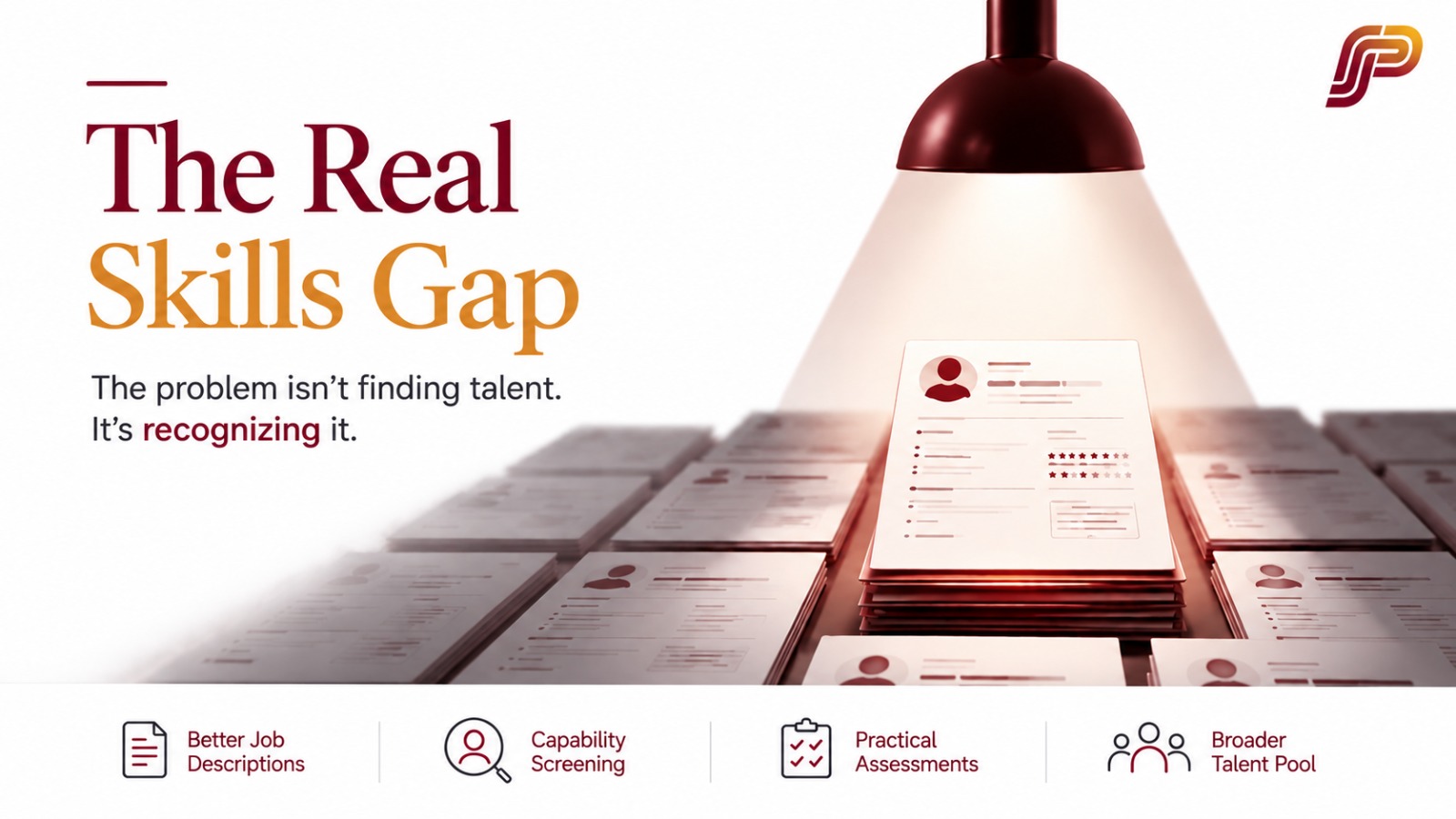
Spotlight shining on a resume placed on a row of dark desks, with text reading The Real Skills Gap, the problem isn't finding talent, it's recognizing it
The talent exists. Most hiring processes just aren’t built to find it.

The Job Description Is the First Place This Breaks

Walk through almost any technical job description right now and you’ll find the same pattern: a long list of specific tools, frameworks, and libraries, treated as hard requirements rather than useful signals. A role that genuinely needs strong problem-solving in distributed systems gets written as “5+ years in specific framework” and every capable engineer who learned the underlying concept on a different stack gets filtered out before a recruiter ever sees their profile.

This is where “impossible to fill” roles actually come from:

  • Job descriptions over-index on framework names and under-index on the underlying capability the role actually requires
  • This produces long, frustrating searches for candidates who, on paper, don’t seem to exist
  • In practice, they exist — they’re just being screened out by a job description that confused a tool with a skill

Teams that correct this — screening for engineers who have solved comparable problems, rather than those who list a specific library — routinely fill roles in weeks that had been sitting open for months. The underlying skill is transferable far more often than most job specs assume
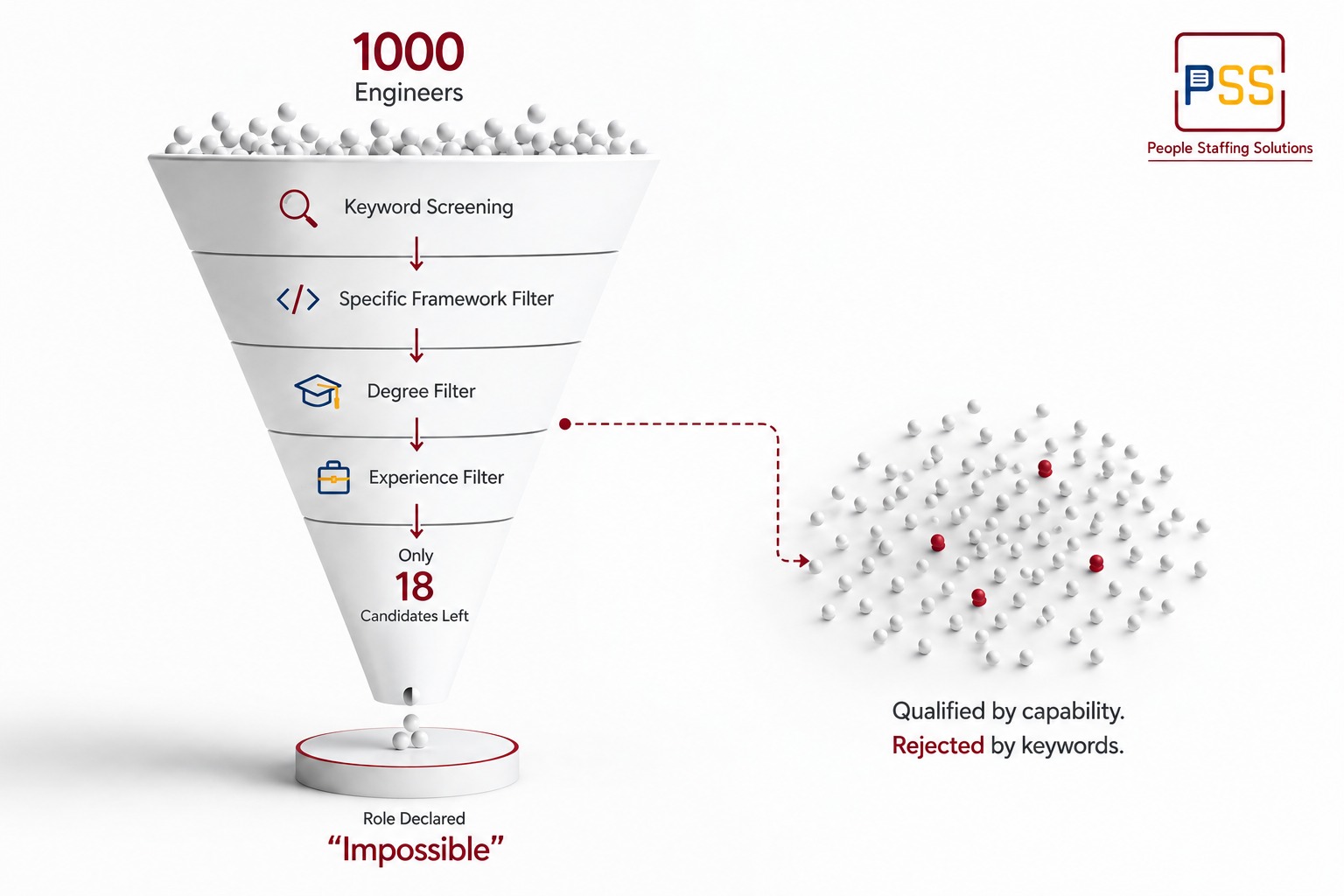
Funnel diagram showing 1000 engineers narrowed down through keyword screening, framework filters, degree filters, and experience filters to only 18 candidates left, with the role declared impossible to fill
1,000 qualified engineers in. 18 left after keyword filters. The role isn’t impossible, the funnel is broken.

The Bigger Shift: Degrees Are Losing Their Grip

This isn’t just a screening tweak — it’s part of a much larger structural shift. Job postings that don’t require a specific degree have grown by more than a third over the past two years, as employers move from credential-based hiring toward skills-based evaluation.

The logic behind this shift is both principled and practical. Principled, because talent doesn’t correlate neatly with access to premium educational institutions — some of the strongest engineers in the market never went through a traditional pipeline. Practical, because demand for skills in AI, cybersecurity, cloud, and data engineering has outpaced the supply coming out of formal degree programs, forcing employers to look beyond the usual talent pools whether they intended to or not.

Some of the most respected product companies in the country have built world-class engineering teams almost entirely from internal training programs rather than elite-institution pipelines — proof that the “pedigree first” model was never the only path to strong engineering talent. It was just the path most companies defaulted to because it was easier to filter for than to actually assess.
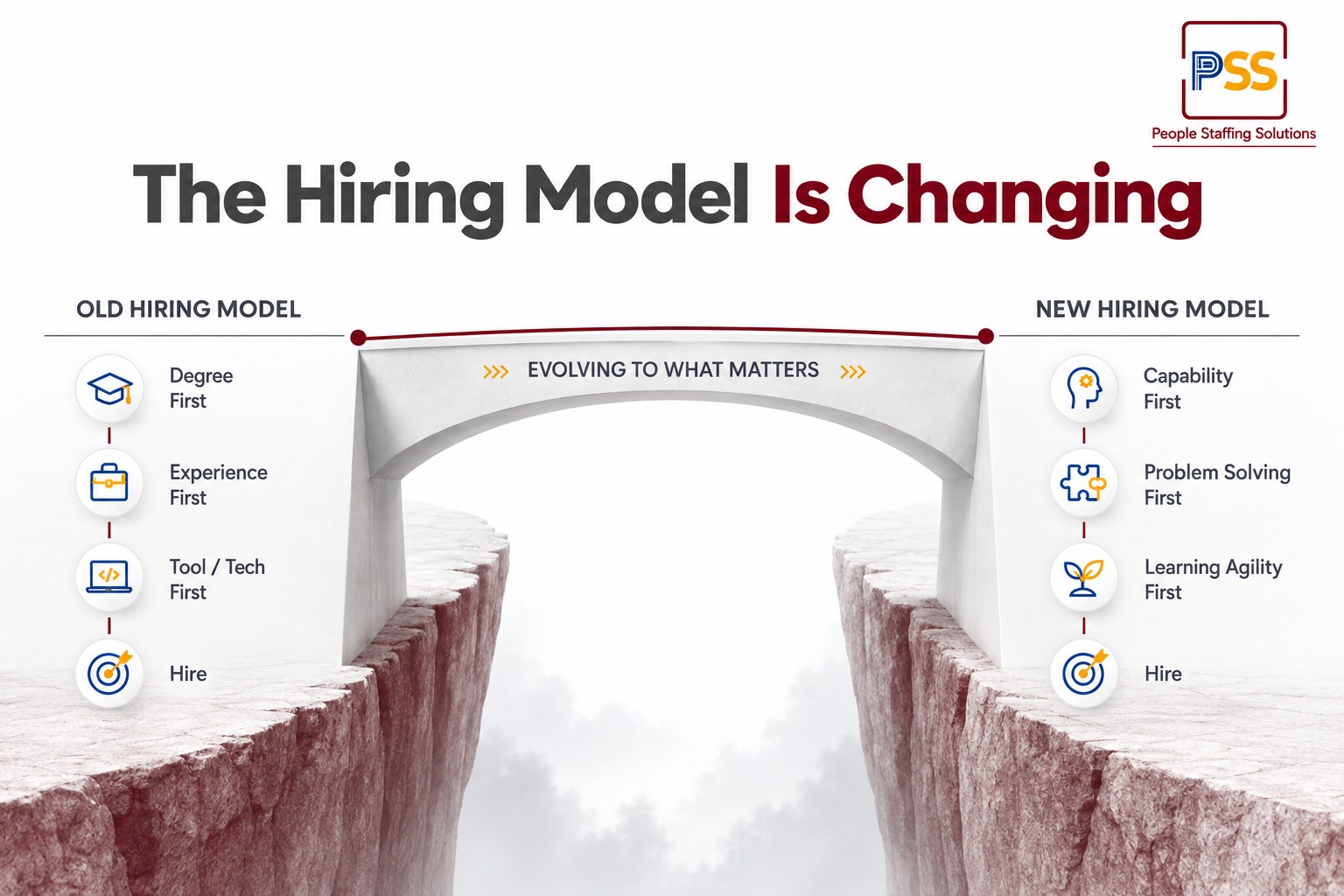
Bridge connecting two cliffs, left side labeled old hiring model with degree, experience, and tool first icons, right side labeled new hiring model with capability, problem solving, and learning agility first icons
From degree first to capability first: the hiring model is evolving.

What This Means in Practice

For CXOs, this reframes a familiar frustration. If a role has been open for months and every hiring update says “the talent just isn’t out there,” the more useful question is whether the job description and screening criteria are actually testing for the capability the role needs or just for familiarity with a specific tool.

For recruiters and hiring managers on the ground, the fix is concrete, not philosophical:

  • Separate must-have skill from nice-to-have tool. A specific framework is rarely the former, even when the job description treats it that way.
  • Screen for demonstrated problem-solving, not keyword density on a resume.
  • Build assessments around real scenarios the role will actually face, not trivia about a specific library’s syntax.
  • Treat degree requirements as a default to question, not a baseline to assume — especially for roles in AI, data, and cloud, where the talent pool has grown faster than traditional credentialing has kept up.
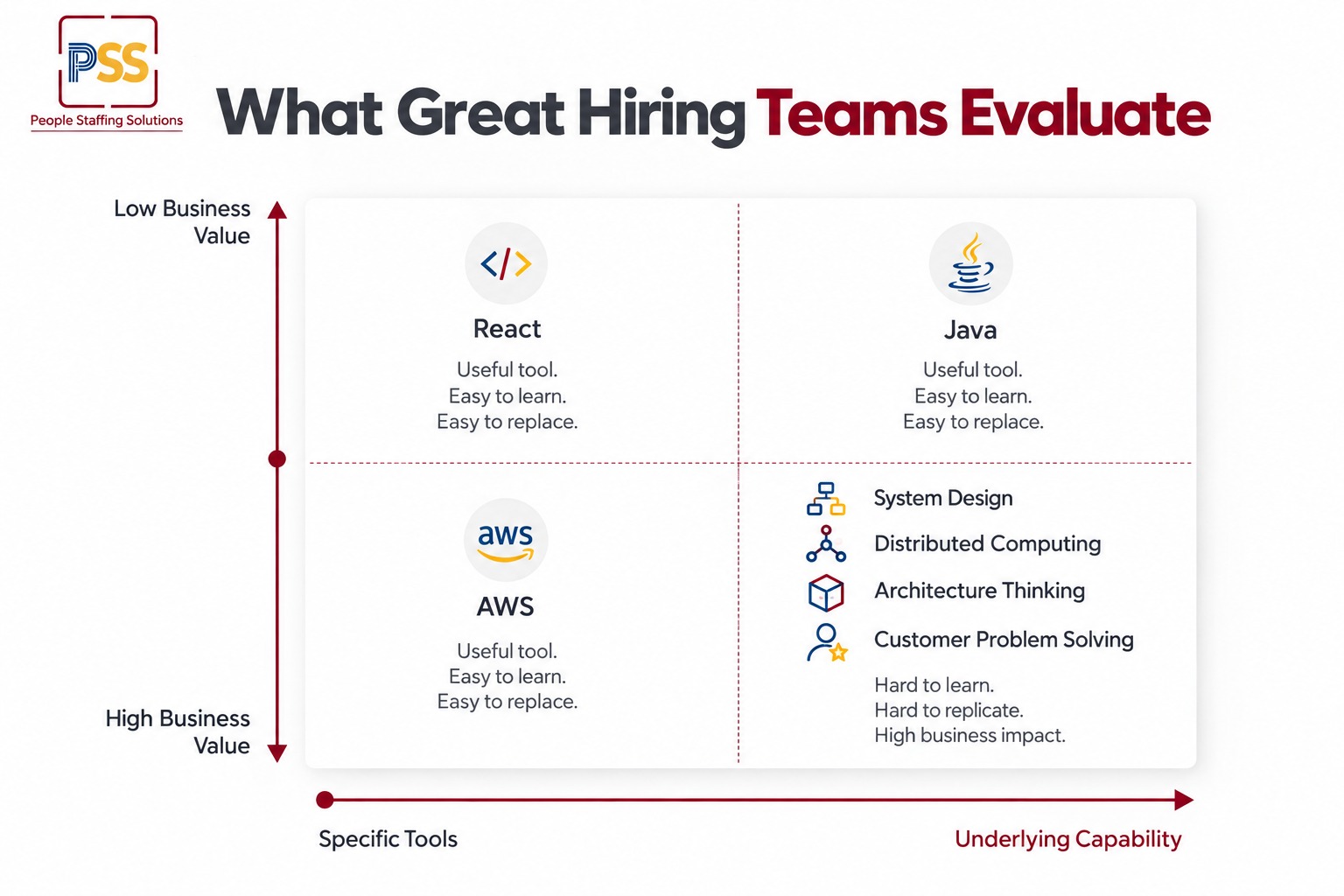
Quadrant chart comparing specific tools like React, Java, and AWS against underlying capabilities like system design, distributed computing, architecture thinking, and customer problem solving, plotted by business value
Tools are easy to learn and replace. Underlying capability is what actually drives business value.

The Bottom Line

The employers hiring successfully right now aren’t the ones with access to a bigger talent pool. They’re the ones who stopped mistaking a tool on a resume for the skill behind it. The skills gap that’s slowing down hiring in 2026 isn’t really a supply problem — it’s a definition problem. Fix how you define the skill you’re actually hiring for, and roles that looked impossible to fill for months start closing in weeks.

We help organizations build high-performing BPO teams—from high-volume fresher hiring to specialized CX leadership roles. If you’re preparing your hiring strategy for 2026, let’s discuss how data-driven recruitment can give your business a competitive edge.

Let’s connect for a Strategic Discussion!



Your 3% Hiring Growth Number Is Hiding a Talent Crisis

The Headline Number Is Lying to You: What’s Really Happening in India’s 2026 IT Hiring Market

Iceberg illustrating hidden depth beneath India's 2026 IT hiring headline growth number

If you’ve seen the topline figure — India’s IT hiring growing a modest 3% year-on-year — you might assume 2026 is a cautious, business-as-usual year for tech talent. That number is technically true and strategically misleading.

Beneath that modest headline, hiring has quietly split in two. AI, cloud, and cybersecurity roles now make up nearly two-thirds of all tech hiring demand. AI-first roles alone account for almost a third of new demand. At the same time, legacy roles — QA, IT support, routine testing — are shrinking as automation absorbs the work.

Companies aren’t hiring less. They’re hiring for a completely different skill set, at a completely different pace, than they were even 18 months ago.

Donut chart showing 90 percent of GenAI-ready tech talent gap in India for 2026
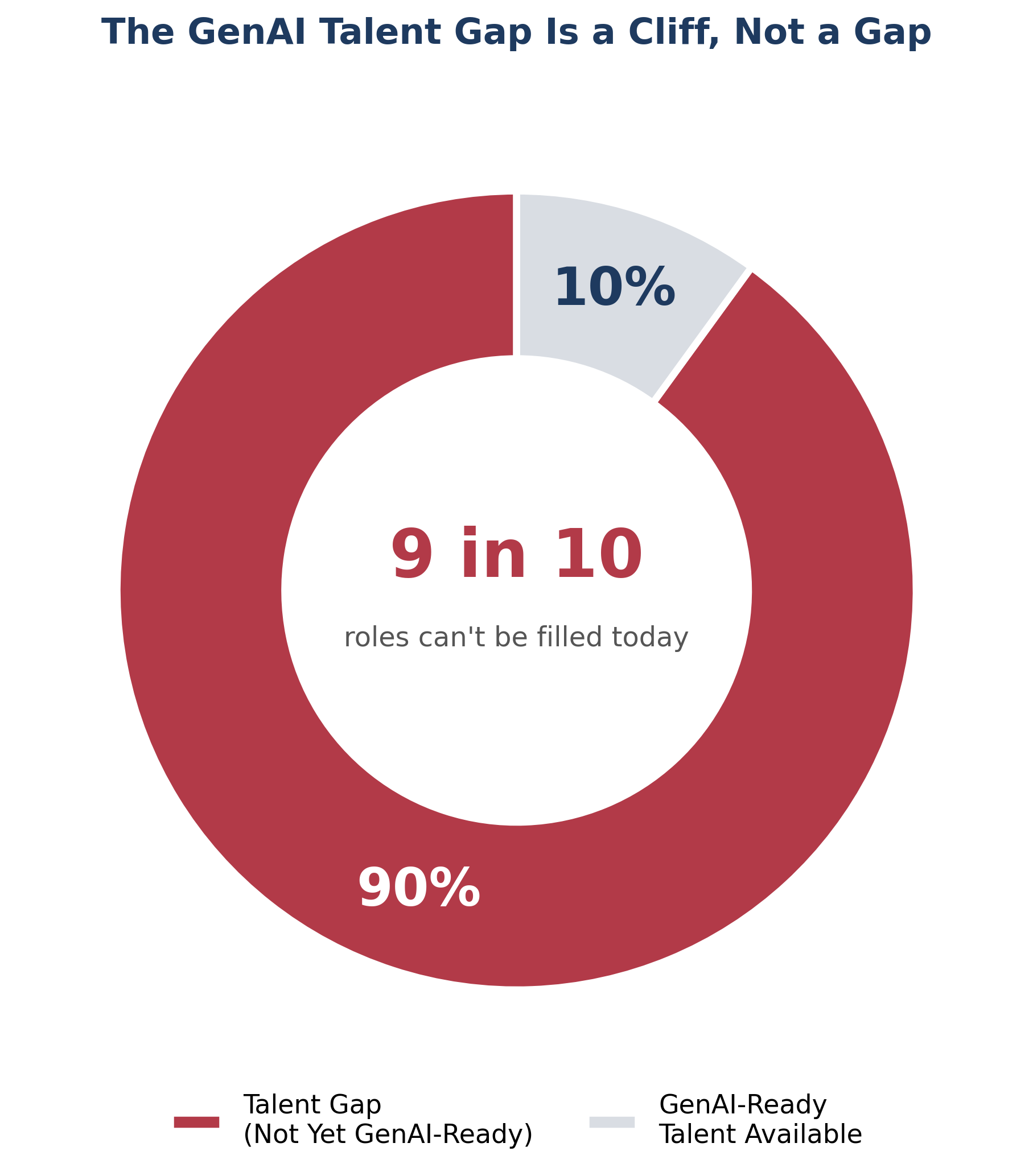
The GenAI talent gap is a cliff, not a gap — 9 in 10 roles can’t be filled today.

The Three Shifts Separating Winners From the Ones Who’ll Find Out Later

  1. The Back Office Just Became the Front Line Global Capability Centres now account for nearly 44% of India’s IT hiring, up sharply from last year, and they’re increasingly hiring for senior, specialized, global-facing roles — not support functions. If GCCs aren’t central to your talent strategy, you’re competing for a shrinking share of the best talent.
  2. The Skill Gap Isn’t a Gap Anymore. It’s a Cliff. Talent ready for generative AI work is in such short supply that roughly 9 in 10 qualified candidates simply don’t exist yet. Cloud and cybersecurity gaps aren’t far behind. This isn’t a recruiting inconvenience — it’s a constraint on how fast any strategy can actually execute.
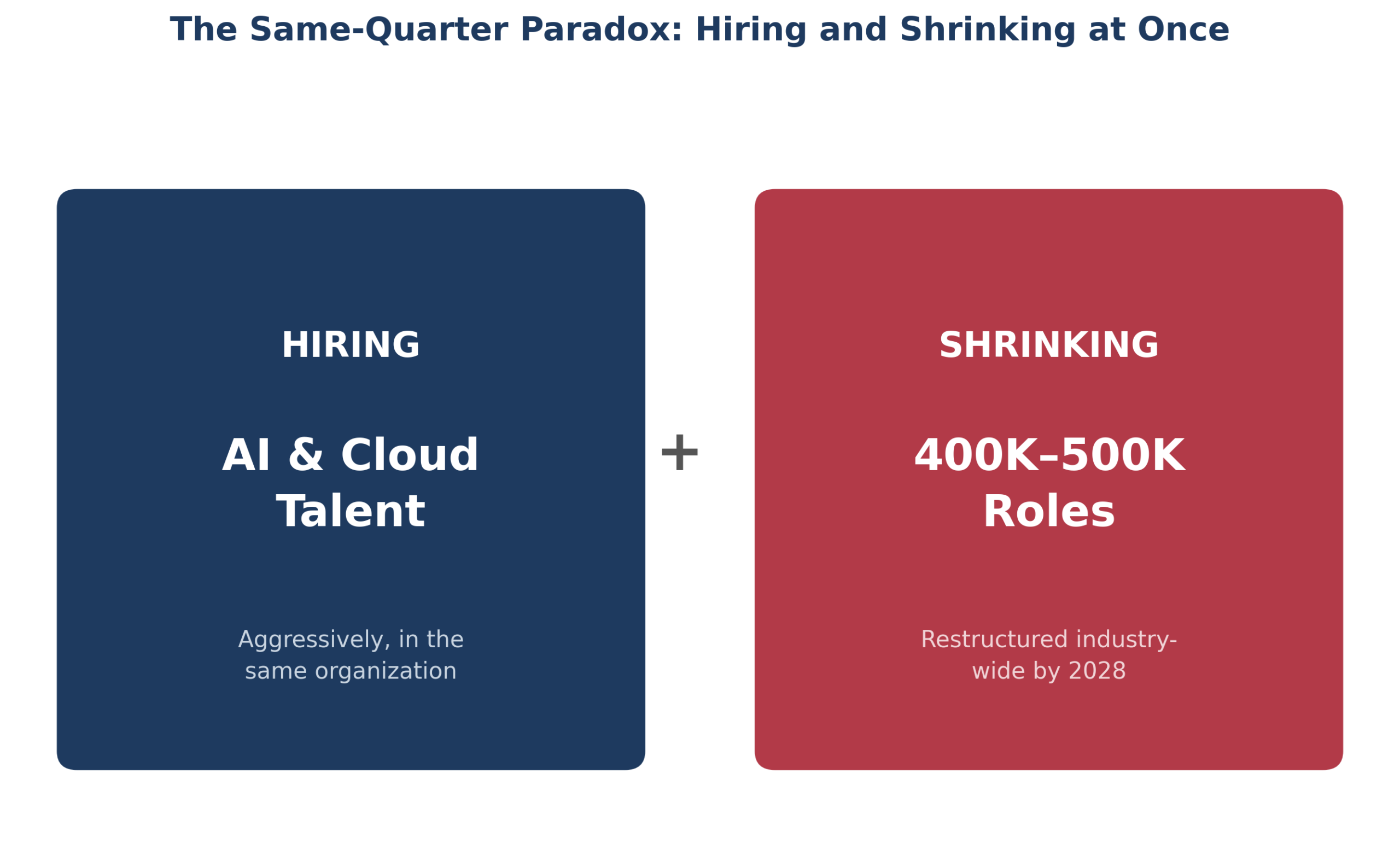
  3. Your Company Is Hiring and Shrinking at the Same Time — And That’s the Point While companies aggressively hire for AI and cloud talent, they’re simultaneously trimming legacy roles automation has made redundant — sometimes in the same quarter, inside the same organization. Hundreds of thousands of mid-career roles are expected to be restructured industry-wide by 2028. Businesses that treat hiring and restructuring as separate processes will fall behind the ones treating it as one continuous rebalancing act.
Chart showing companies simultaneously hiring AI and cloud talent while restructuring 400000 to 500000 legacy roles by 2028
The same-quarter paradox — hiring and shrinking at once.


There’s a geography shift underneath all of this too — growth is moving toward GCC-heavy hubs and Tier II cities, while some traditional metro markets are actually contracting. Talent sourcing strategies built purely around the old metro playbook are already losing ground.


Stop Hiring for Roles. Start Investing in Capability.

The organizations getting this right have stopped asking “do we need to hire for this role” and started asking “what’s the smartest way to acquire this capability.”

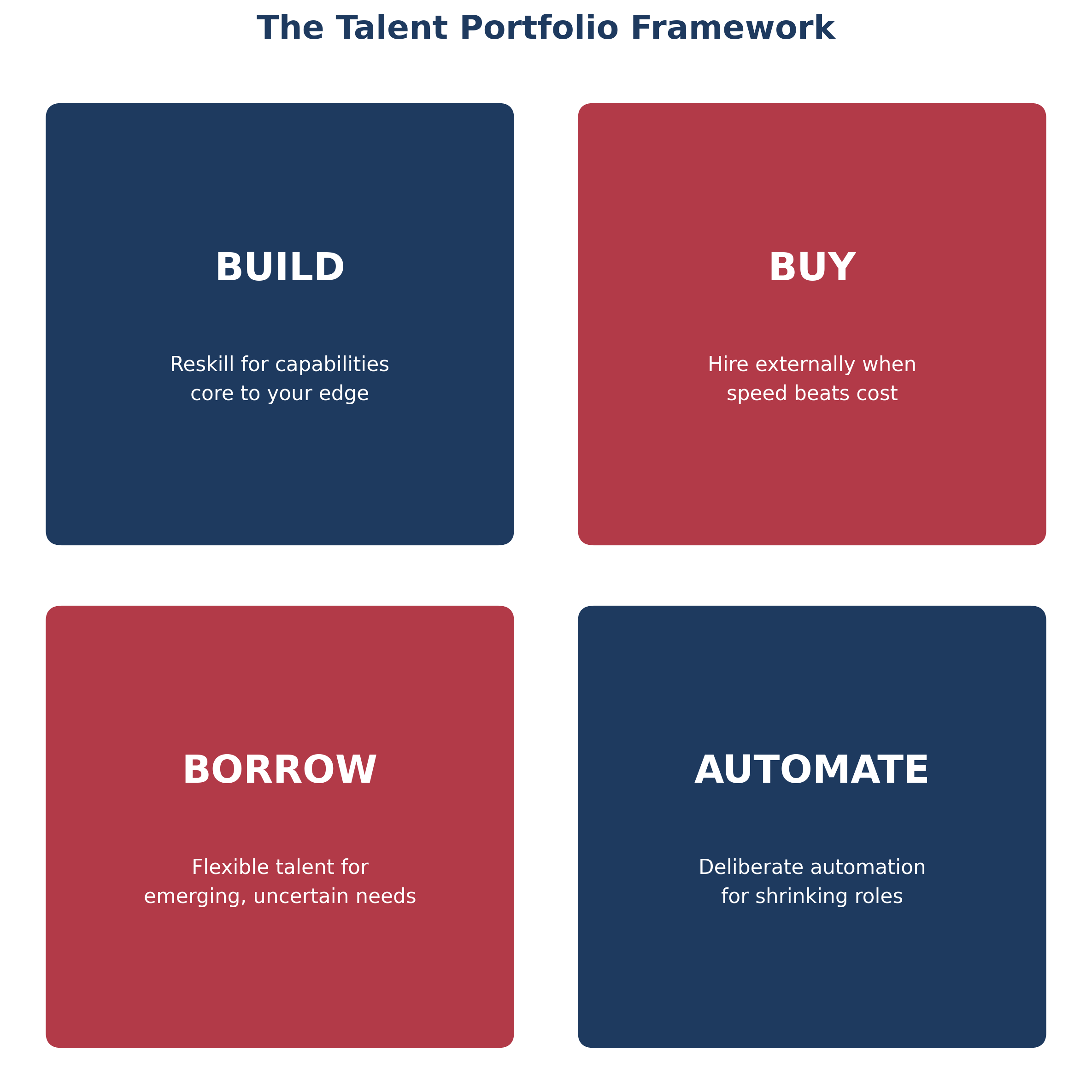
That means treating talent like a portfolio, with four levers:

  • Build — invest in reskilling for capabilities core to your edge, especially where external hiring means competing in an overheated market.
  • Buy — hire externally only where speed matters more than cost, and where the skill is too scarce to build in time.
  • Borrow — use contract and flexible talent for emerging or uncertain needs. This model is growing fast for a reason.
  • Automate — for roles already shrinking, treat automation as a deliberate strategy, not a reaction.
Talent portfolio framework diagram showing build, buy, borrow, and automate hiring strategies
The Talent Portfolio Framework — four levers for smarter talent acquisition.

The businesses winning right now aren’t the ones hiring the most. They’re the ones using the right lever for the right capability, and revisiting that mix constantly instead of once a year.


The Opening We Can’t Afford to Miss

This shift isn’t a passing trend — it’s a structural rewrite of how talent gets built, bought, and deployed. And it creates a real opening for us.

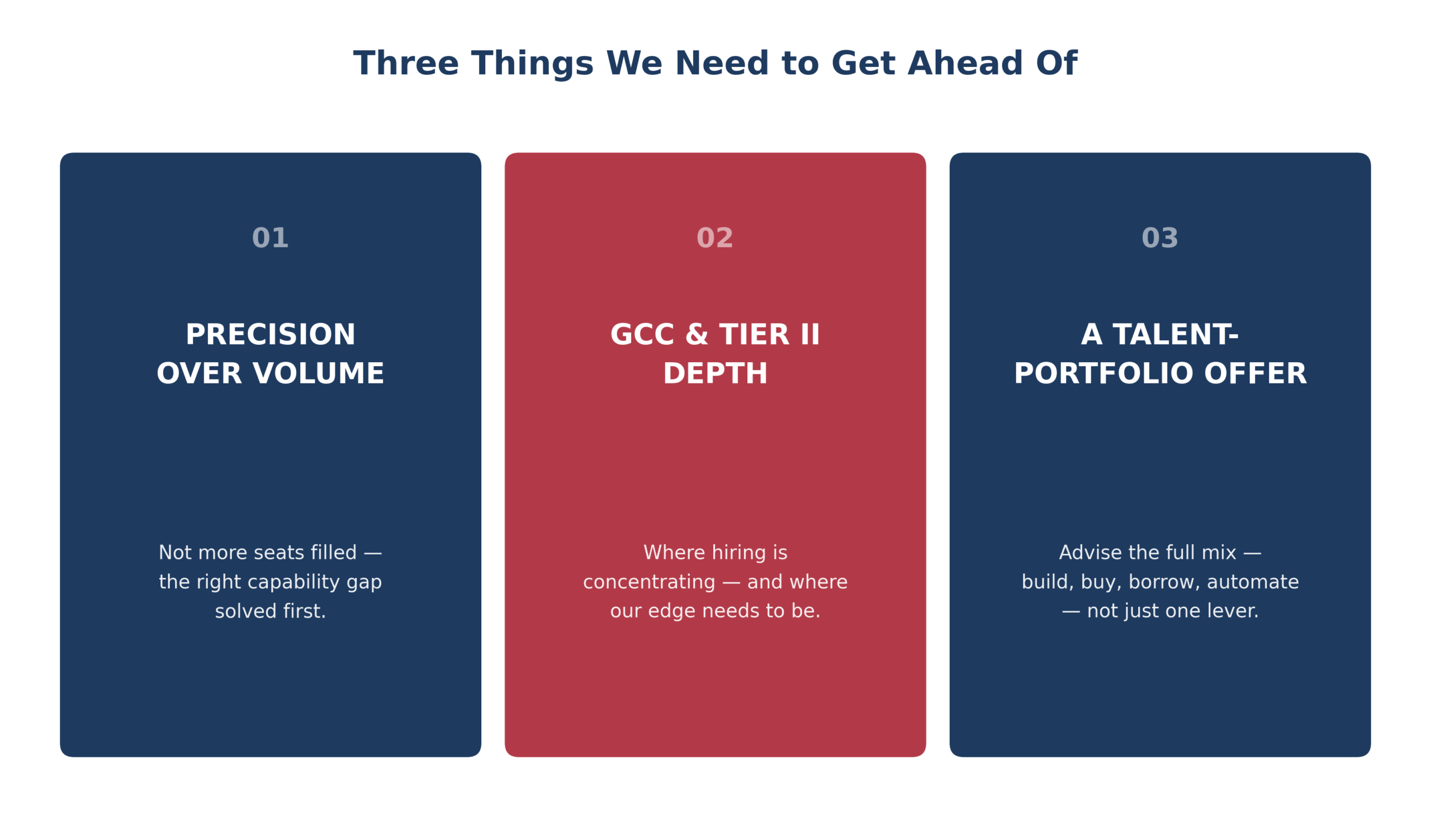
Three things we need to get ahead of:

  • Precision over volume. Clients don’t need help filling more seats — they need help identifying exactly which capability gap is costing them the most, and solving that first. Our value has to be diagnostic, not just transactional.
  • GCC and Tier II expertise as a differentiator. As hiring concentrates around GCCs and emerging city hubs, firms with genuine depth in these markets will out-position generalist competitors fast. This is where we should be building our sharpest capability.
  • A talent-portfolio offering, not just a hiring service. Clients are going to need help thinking across build, buy, borrow, and automate — not just executing one of those levers. The consultancies who can advise on the mix, not just fill the roles, will own the highest-value conversations in this market.
Three strategic hiring priorities for 2026 — precision over volume, GCC and Tier II depth, talent portfolio offering
Three things we need to get ahead of in 2026’s talent market.


The CXOs who move on this now will be the ones defining the next five years of their industries. Our job is to make sure we’re the ones helping them get there first.

LinkedIn
WhatsApp
Twitter
Facebook
Instagram