Tier 2 Cities and GCCs Are Quietly Rewriting India’s Tech Salary Map

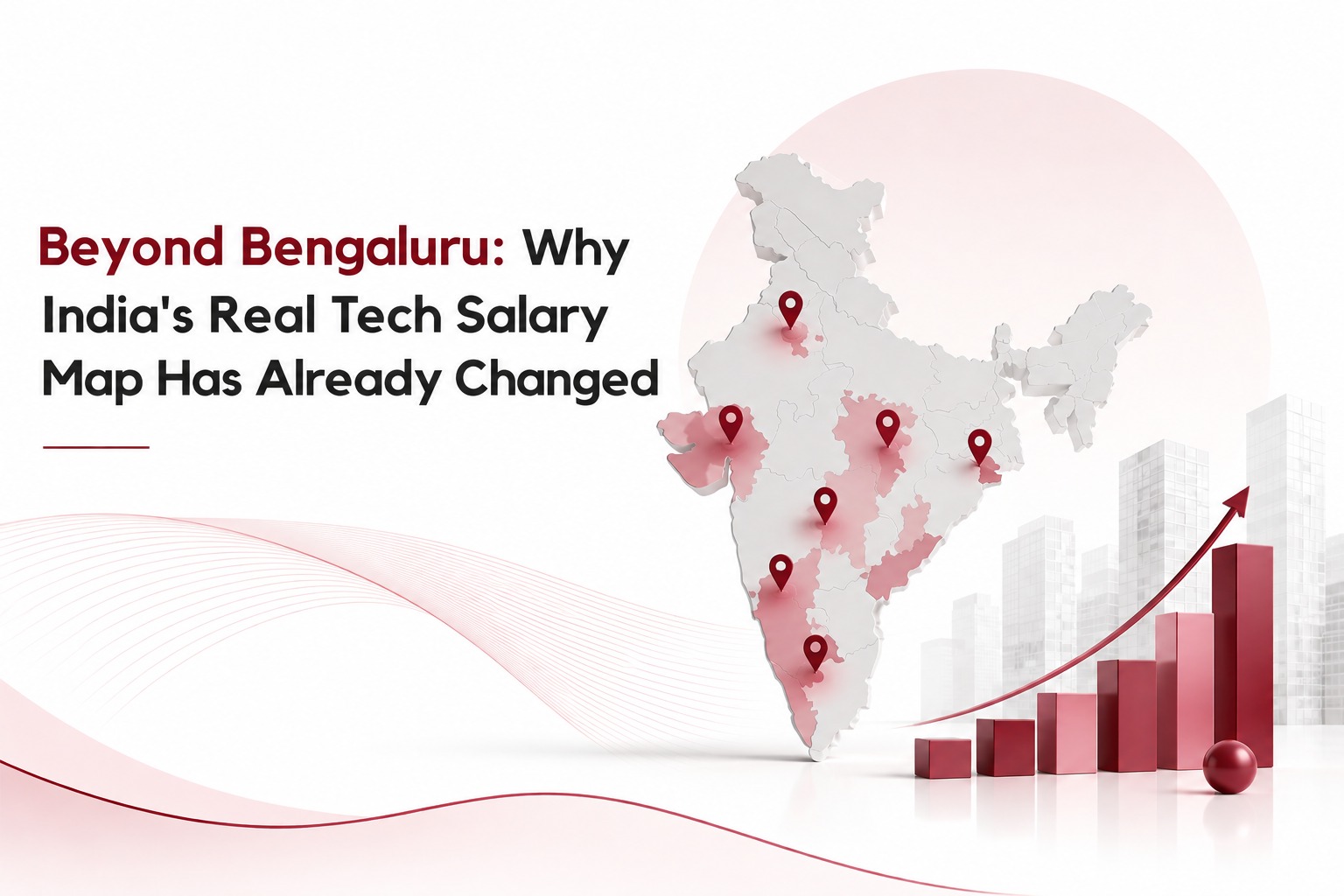
Beyond Bengaluru: Why India’s Real Tech Salary Map Has Already Changed
Meta description: Tier-2 cities and Global Capability Centers are quietly rewriting India’s tech salary benchmarks. Here’s what CTOs and hiring teams need to know before their next hiring plan.

Most hiring plans still start with the same assumption: tech talent lives in Bengaluru, Hyderabad, and Pune, and everything else is a regional afterthought. That assumption is now costing companies money and speed — because two separate shifts have quietly rewritten where genuine tech capability actually sits in India, and what it costs to access it.

  • Tier-2 cities went from 8% to 18% of new tech job creation between 2020 and 2025, at salary benchmarks meaningfully below metro rates
  • Cities like Indore, Coimbatore, Nagpur, Kochi, and Chandigarh now carry genuine mid-level tech capability, with lower attrition than metros
  • Global Capability Centers have crossed 1,580 in number with a combined workforce nearing 1.9 million, and are resetting compensation benchmarks market-wide
  • The catch: tier-2 markets are strong at mid-level, but senior leadership usually has to be attracted in, not found locally
Map of India with orange location markers across multiple cities next to a rising orange bar chart, illustrating the shift in India's tech salary landscape beyond Bengaluru
Bengaluru isn’t the only benchmark anymore. India’s tech salary map has already shifted.

The Tier-2 Shift Is Real, Not a Trend Piece

Cities like Indore, Bhubaneswar, Nagpur, Kolkata, Coimbatore, Pune, Ahmedabad, Jaipur, Kochi, Chandigarh, and Thiruvananthapuram now carry genuine technology capability — not just support functions — at salary benchmarks meaningfully below Bengaluru, and with noticeably lower attrition.

The scale of the shift is the part most hiring teams haven’t priced in. Tier-2 cities accounted for roughly 8% of new tech job creation in 2020. By 2025, that number had climbed to around 18% — and the trajectory is accelerating, not plateauing. Hybrid and remote work norms made this geographic spread operationally viable; cost pressure made it strategically attractive. What started as a pandemic-era experiment has become a mainstream hiring strategy for second-site engineering and shared-services teams.

Illustration of connected city skylines with glowing pathways and human figures converging toward them, with text reading Tier 2 shift is real, not a trend piece
Tier 2 tech hiring isn’t a pandemic era experiment anymore. It’s a sustained structural shift.

The Honest Catch Most Pitches Leave Out

It would be easy to stop there and call tier-2 hiring a straightforward win. It isn’t quite that simple, and pretending otherwise is how hiring plans go wrong six months in.

Tier-2 markets have real depth at the mid-level — engineers with two to seven years of experience who are strong, stable, and considerably less likely to job-hop than their metro counterparts. What these markets don’t yet have is deep senior leadership bench strength. A tier-2 hiring strategy that assumes it can staff an entire engineering leadership layer locally usually stalls. The more realistic approach is building mid-level capacity locally while attracting senior leadership in — either by relocating experienced leaders or running the team under remote senior oversight from a metro base.

The GCC Effect: A Second Force Resetting the Same Market

At the same time, a second and largely separate shift is putting upward pressure on the exact same talent pool: the rapid expansion of Global Capability Centers.

India now hosts over 1,580 GCCs, with a combined workforce approaching 1.9 million professionals — and roughly 50 new centers opening every year. These are no longer the back-office, cost-arbitrage operations they were a decade ago. Today’s GCCs function as genuine innovation hubs, competing directly with India’s best-funded startups and product companies for the same senior and specialized talent.

That competition has consequences well beyond the companies directly hiring for GCC roles. When a handful of major GCCs in a city start paying product-company-level compensation for senior engineering and AI talent, the entire local salary band shifts upward — including for companies that have nothing to do with GCCs at all. For many hiring teams, this is the real, unnamed reason a role that used to fill easily has suddenly gotten harder and more expensive, without any obvious change in their own hiring process.

Translucent glass sphere containing a glowing city skyline with a location pin at its center, representing tier 2 cities as hubs of real savings and real technology capability
Real capability. Real cost savings. Tier 2 cities are no longer a compromise.

What This Means for Your Next Hiring Plan

Put together, these two shifts point to the same practical conclusion: the old mental map of Indian tech salaries — metro-expensive, everywhere-else-cheap — no longer holds cleanly in either direction. Tier-2 cities offer real savings and real capability, but not unlimited depth. GCCs are quietly inflating compensation in cities that look, on paper, like they should still be cost-efficient.

The hiring teams getting this right are treating both forces as inputs into a single decision, not separate line items — benchmarking pay by city and seniority band specifically, rather than applying one national number, and building tier-2 strategies around mid-level capacity with a deliberate plan for senior leadership from day one.

Diagram showing several small city models connected by lines through a central metallic sphere to three large modern buildings, representing Global Capability Centers pulling talent and compensation benchmarks across cities
Global Capability Centers are quietly resetting salary benchmarks, even for companies that never compete with them directly.

The Bottom Line

The real story isn’t “Bengaluru versus everywhere else.” It’s that India’s tech salary map is being pulled in two directions at once — tier-2 cities pulling costs down, GCCs pulling compensation up in the same geographies. Hiring plans built on last year’s assumptions about either force are already out of date.

Frequently Asked Questions

Are tier-2 cities actually cheaper for tech hiring in 2026? Generally yes at the mid-level, though the gap is narrowing in cities where GCCs have established a strong local presence and pushed compensation upward.

Can a company build a full engineering team entirely in a tier-2 city? Mid-level teams, yes. Senior leadership usually still needs to be attracted in rather than sourced locally, at least in the near term.

Why do GCCs affect salaries at companies that don’t compete with them directly? Because compensation benchmarks are set locally, not company by company. A few large employers paying premium rates in a city resets what every employer in that market has to offer to stay competitive.


The Real Skills Gap: Why Impossible to Fill Roles Are a Hiring Problem, Not a Talent Problem

India’s employability rate just hit a five-year high — yet most employers still can’t fill critical roles. Here’s what the data actually says about the skills gap, and how to fix it.

Here’s a contradiction most hiring leaders have felt but rarely seen written down: India’s overall employability rate recently climbed to its highest level in five years, driven by rising digital literacy and a wave of skills-based certification programs. And yet, well over 60% of employers still report serious difficulty filling their most critical roles particularly in emerging technology domains.

Both of those things are true at the same time. That’s not a contradiction in the data. It’s a diagnosis. The problem in 2026 isn’t a shortage of skilled people. It’s a mismatch between the skills the market actually needs and the way most companies are still screening for them.

  • 60 % + of employers can’t fill critical roles despite record-high employability — it’s a screening mismatch, not a shortage
  • Listing tools as “must-haves” filters out capable candidates who learned the skill on a different stack
  • Degree-free postings have grown over a third in two years as skills-based hiring goes mainstream
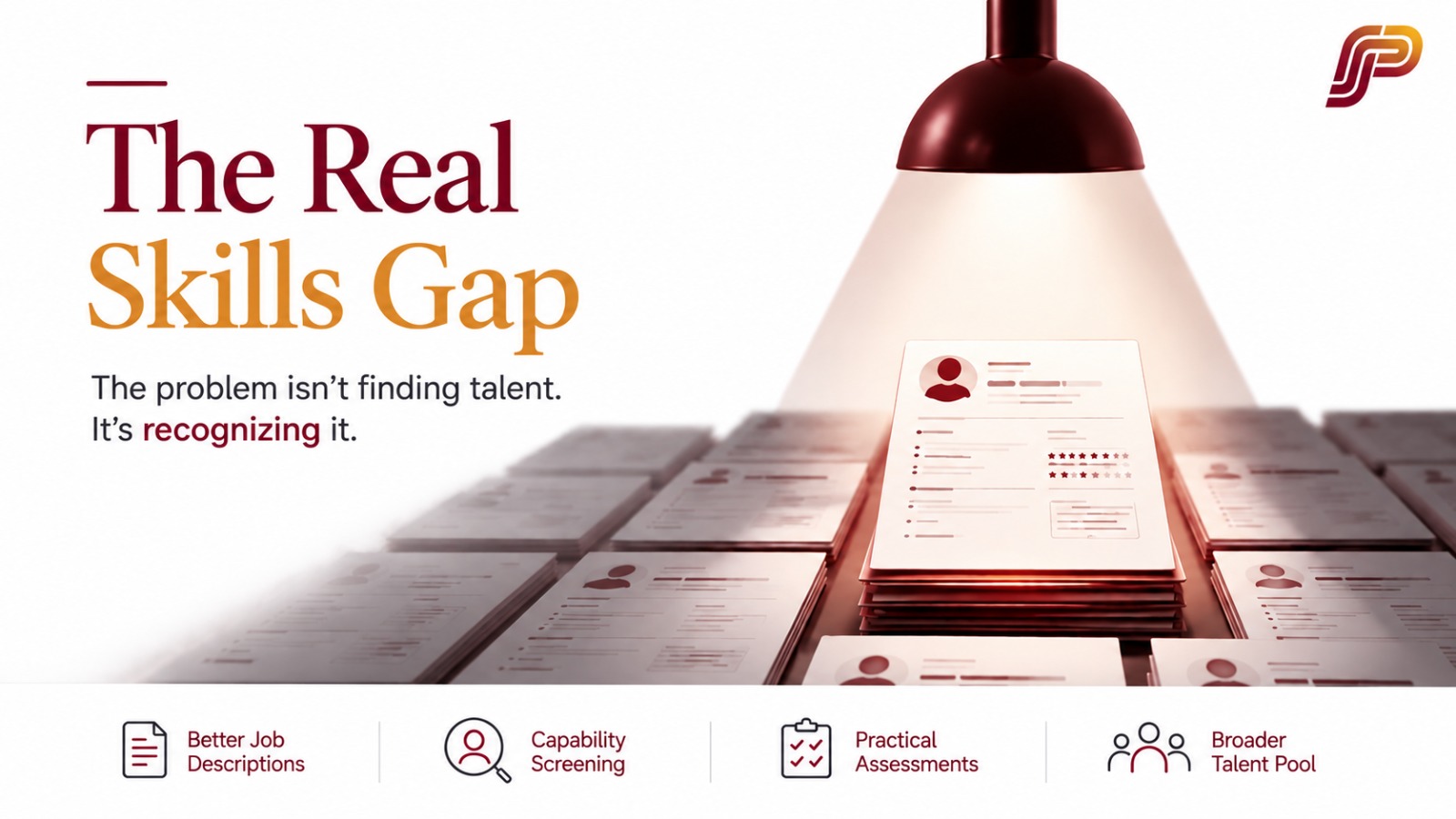
Spotlight shining on a resume placed on a row of dark desks, with text reading The Real Skills Gap, the problem isn't finding talent, it's recognizing it
The talent exists. Most hiring processes just aren’t built to find it.

The Job Description Is the First Place This Breaks

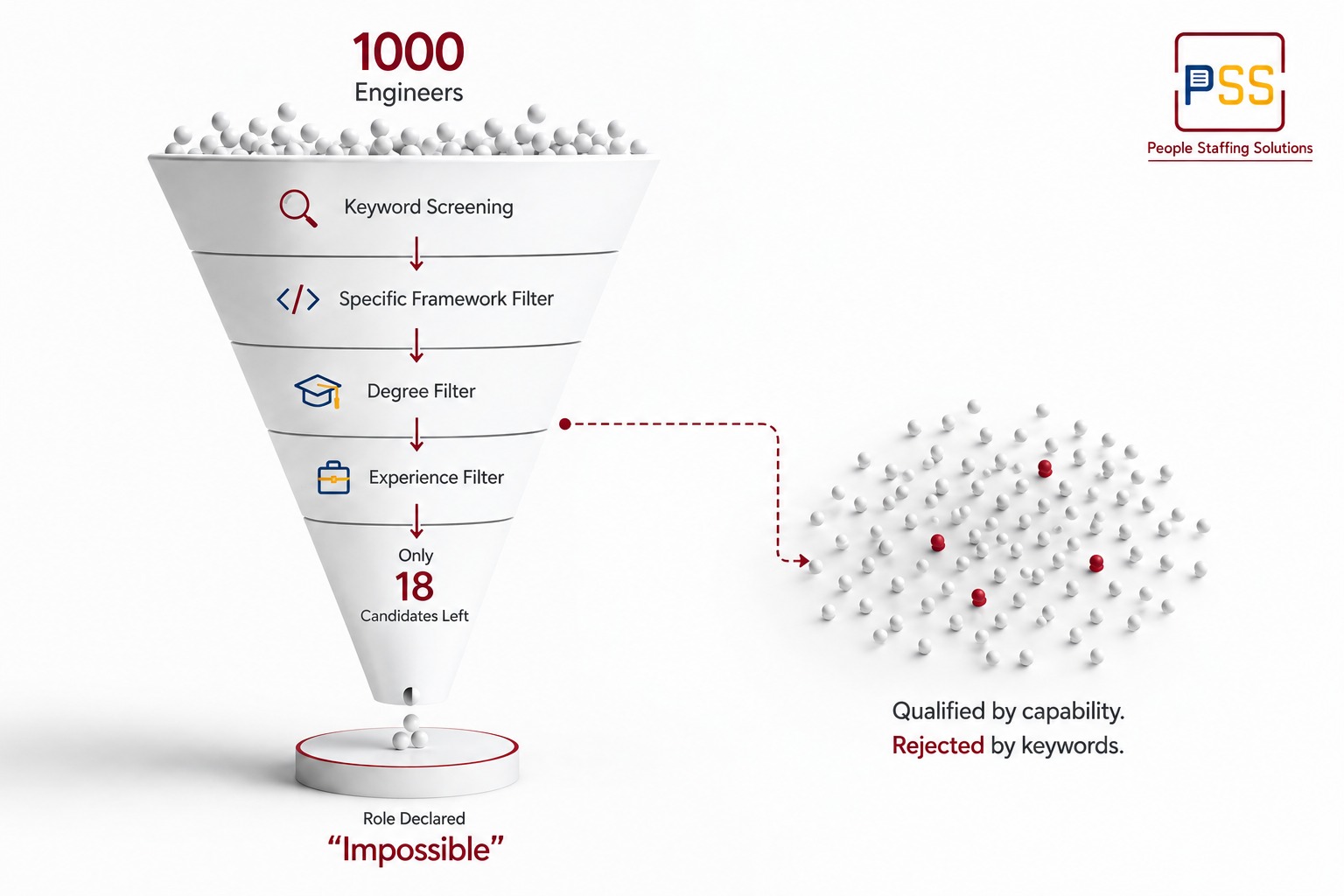
Walk through almost any technical job description right now and you’ll find the same pattern: a long list of specific tools, frameworks, and libraries, treated as hard requirements rather than useful signals. A role that genuinely needs strong problem-solving in distributed systems gets written as “5+ years in specific framework” and every capable engineer who learned the underlying concept on a different stack gets filtered out before a recruiter ever sees their profile.

This is where “impossible to fill” roles actually come from:

  • Job descriptions over-index on framework names and under-index on the underlying capability the role actually requires
  • This produces long, frustrating searches for candidates who, on paper, don’t seem to exist
  • In practice, they exist — they’re just being screened out by a job description that confused a tool with a skill

Teams that correct this — screening for engineers who have solved comparable problems, rather than those who list a specific library — routinely fill roles in weeks that had been sitting open for months. The underlying skill is transferable far more often than most job specs assume

Funnel diagram showing 1000 engineers narrowed down through keyword screening, framework filters, degree filters, and experience filters to only 18 candidates left, with the role declared impossible to fill
1,000 qualified engineers in. 18 left after keyword filters. The role isn’t impossible, the funnel is broken.

The Bigger Shift: Degrees Are Losing Their Grip

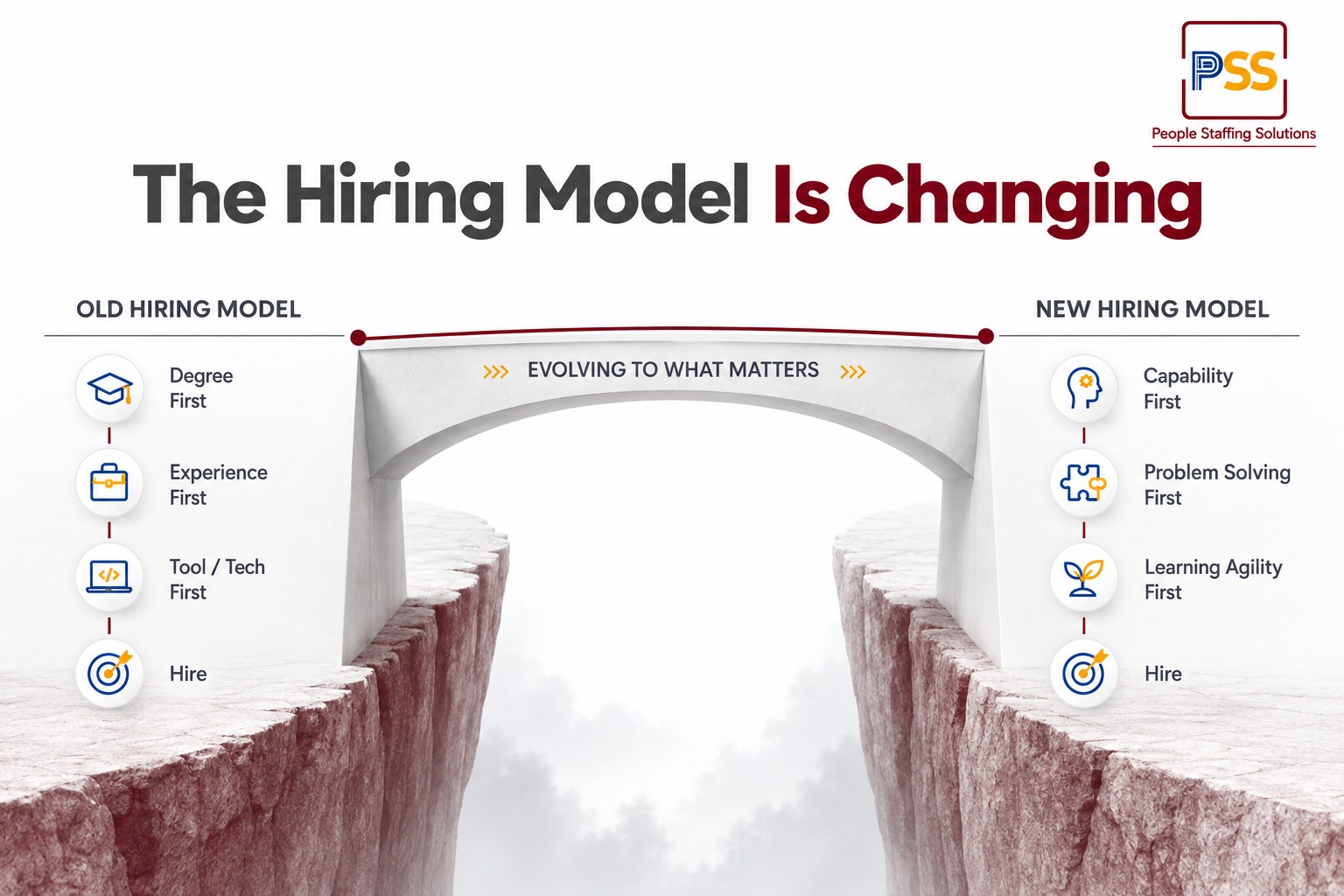
This isn’t just a screening tweak — it’s part of a much larger structural shift. Job postings that don’t require a specific degree have grown by more than a third over the past two years, as employers move from credential-based hiring toward skills-based evaluation.

The logic behind this shift is both principled and practical. Principled, because talent doesn’t correlate neatly with access to premium educational institutions — some of the strongest engineers in the market never went through a traditional pipeline. Practical, because demand for skills in AI, cybersecurity, cloud, and data engineering has outpaced the supply coming out of formal degree programs, forcing employers to look beyond the usual talent pools whether they intended to or not.

Some of the most respected product companies in the country have built world-class engineering teams almost entirely from internal training programs rather than elite-institution pipelines — proof that the “pedigree first” model was never the only path to strong engineering talent. It was just the path most companies defaulted to because it was easier to filter for than to actually assess.

Bridge connecting two cliffs, left side labeled old hiring model with degree, experience, and tool first icons, right side labeled new hiring model with capability, problem solving, and learning agility first icons
From degree first to capability first: the hiring model is evolving.

What This Means in Practice

For CXOs, this reframes a familiar frustration. If a role has been open for months and every hiring update says “the talent just isn’t out there,” the more useful question is whether the job description and screening criteria are actually testing for the capability the role needs or just for familiarity with a specific tool.

For recruiters and hiring managers on the ground, the fix is concrete, not philosophical:

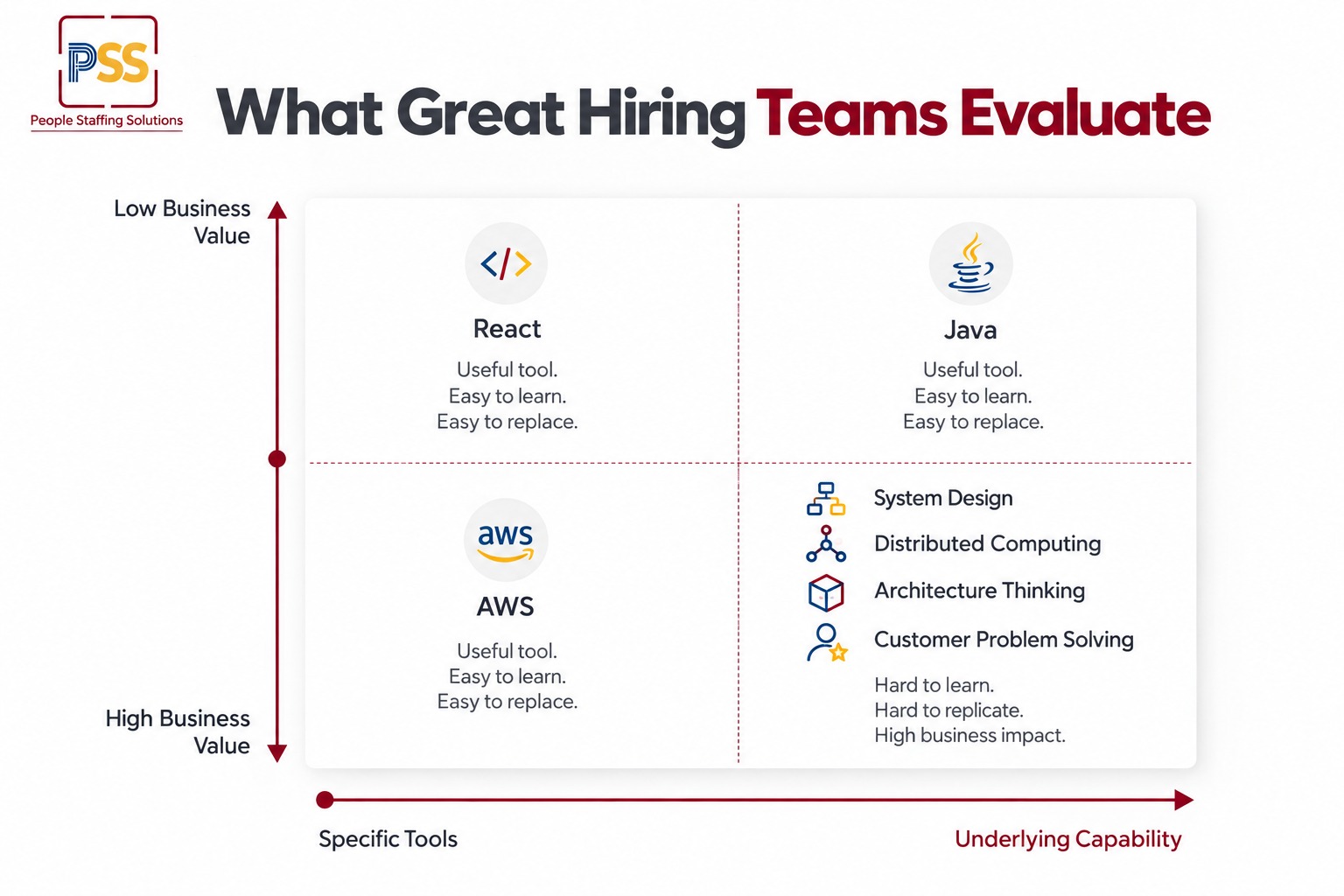
  • Separate must-have skill from nice-to-have tool. A specific framework is rarely the former, even when the job description treats it that way.
  • Screen for demonstrated problem-solving, not keyword density on a resume.
  • Build assessments around real scenarios the role will actually face, not trivia about a specific library’s syntax.
  • Treat degree requirements as a default to question, not a baseline to assume — especially for roles in AI, data, and cloud, where the talent pool has grown faster than traditional credentialing has kept up.
Quadrant chart comparing specific tools like React, Java, and AWS against underlying capabilities like system design, distributed computing, architecture thinking, and customer problem solving, plotted by business value
Tools are easy to learn and replace. Underlying capability is what actually drives business value.

The Bottom Line

The employers hiring successfully right now aren’t the ones with access to a bigger talent pool. They’re the ones who stopped mistaking a tool on a resume for the skill behind it. The skills gap that’s slowing down hiring in 2026 isn’t really a supply problem — it’s a definition problem. Fix how you define the skill you’re actually hiring for, and roles that looked impossible to fill for months start closing in weeks.

We help organizations build high-performing BPO teams—from high-volume fresher hiring to specialized CX leadership roles. If you’re preparing your hiring strategy for 2026, let’s discuss how data-driven recruitment can give your business a competitive edge.

Let’s connect for a Strategic Discussion!


BPO Hiring Grew 21% in 2026: Why AI Made the Industry More Human, Not Less

BPO Hiring Just Grew 21%. The “AI Is Killing This Industry” Story Was Wrong

If you’ve been hearing that AI is quietly gutting the BPO industry, the data says otherwise. BPO and ITES hiring grew 21% year-on-year in early 2026 — one of the fastest-growing sectors in the entire job market, holding double-digit growth for three straight months.

A man and woman shaking hands across a table with a digital human face made of light particles in the background, symbolizing AI and human collaboration
AI supports the process — people still make the connection

The details underneath make it more interesting:

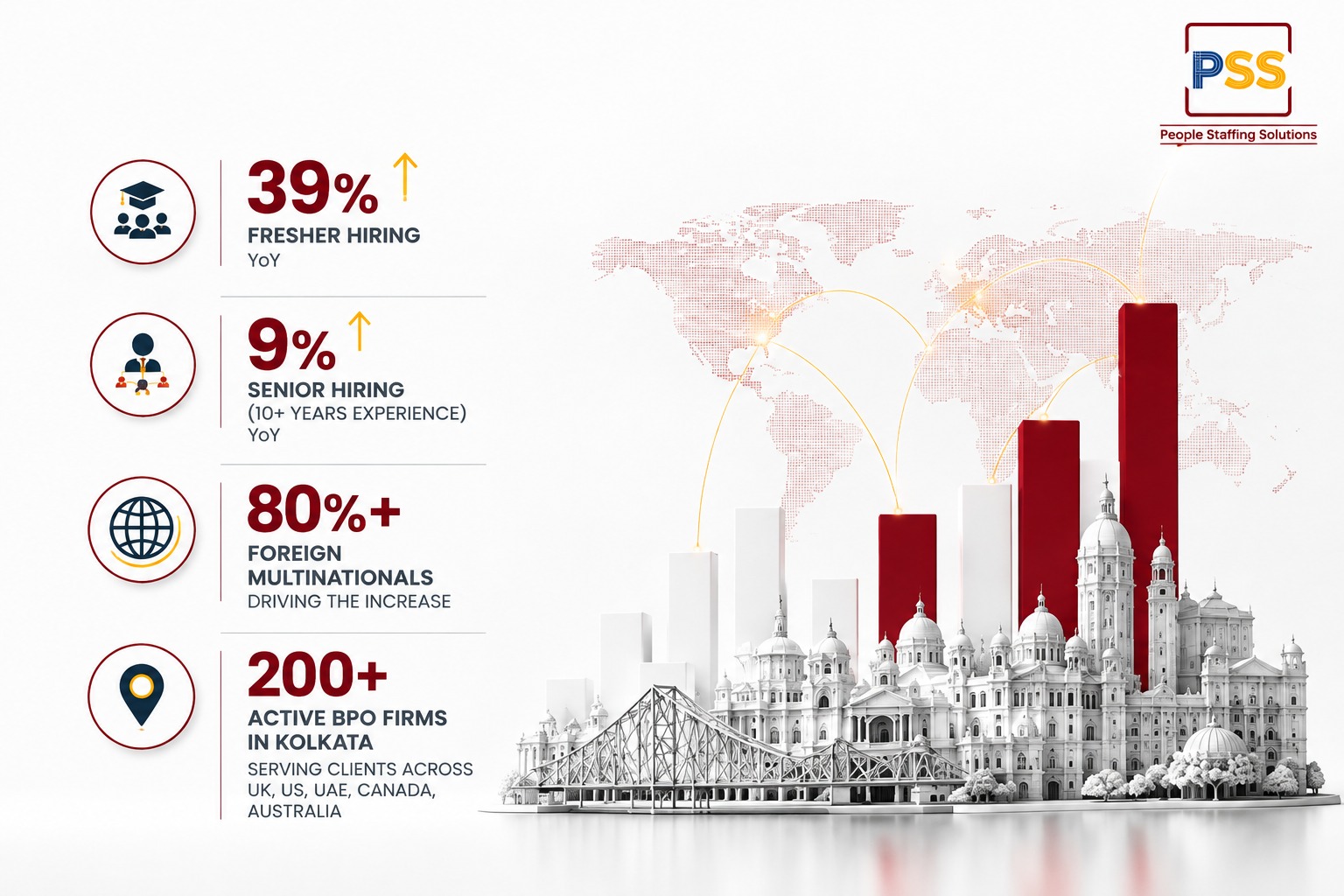
  • Fresher hiring grew 39% YoY — the single largest entry-level surge of any tracked sector. If AI were simply replacing junior roles, this number shouldn’t exist.
  • Senior hiring (10+ years experience) grew 9% YoY — this isn’t a volume story or an entry-level story alone. It’s both, happening together.
  • Foreign multinationals drove over 80% of the increase — this isn’t a domestic recovery. It’s global demand, actively choosing India.
  • Kolkata alone has 200+ active BPO firms serving clients across the US, UK, UAE, Canada, and Australia — for hiring teams on the ground, this isn’t a forecast. It’s already showing up in mandates.
Infographic listing BPO hiring statistics including 39 percent fresher hiring growth, 9 percent senior hiring growth, 80 percent foreign multinational demand, and 200 plus active firms in Kolkata, with a city skyline in the background
Fresher hiring, senior hiring, and global demand are all rising together

AI Didn’t Shrink the BPO Job. It Humanified It.

Here’s the part most narratives get backwards.

  • AI and automation haven’t eliminated the BPO agent — they’ve eliminated the scripted version of that job.
  • Chatbots now handle what never needed a human in the first place: password resets, order status checks, FAQ-level queries.
  • What’s left is everything a script couldn’t cover — the angry customer, the ambiguous complaint, the conversation that needs judgment and patience instead of a flowchart.

That’s the real shift. BPO hiring isn’t becoming more automated — it’s becoming more human. The industry spent two decades hiring people to sound like scripts. It’s now hiring people specifically because they don’t.

That’s exactly why fresher hiring is surging. Companies aren’t hiring fewer people — they’re hiring people for the parts of the job AI genuinely can’t do. The job didn’t disappear. It got more human, and more valuable because of it.

The New Hiring Currency: Human Skills, Not Just Experience

What actually gets someone hired is changing:

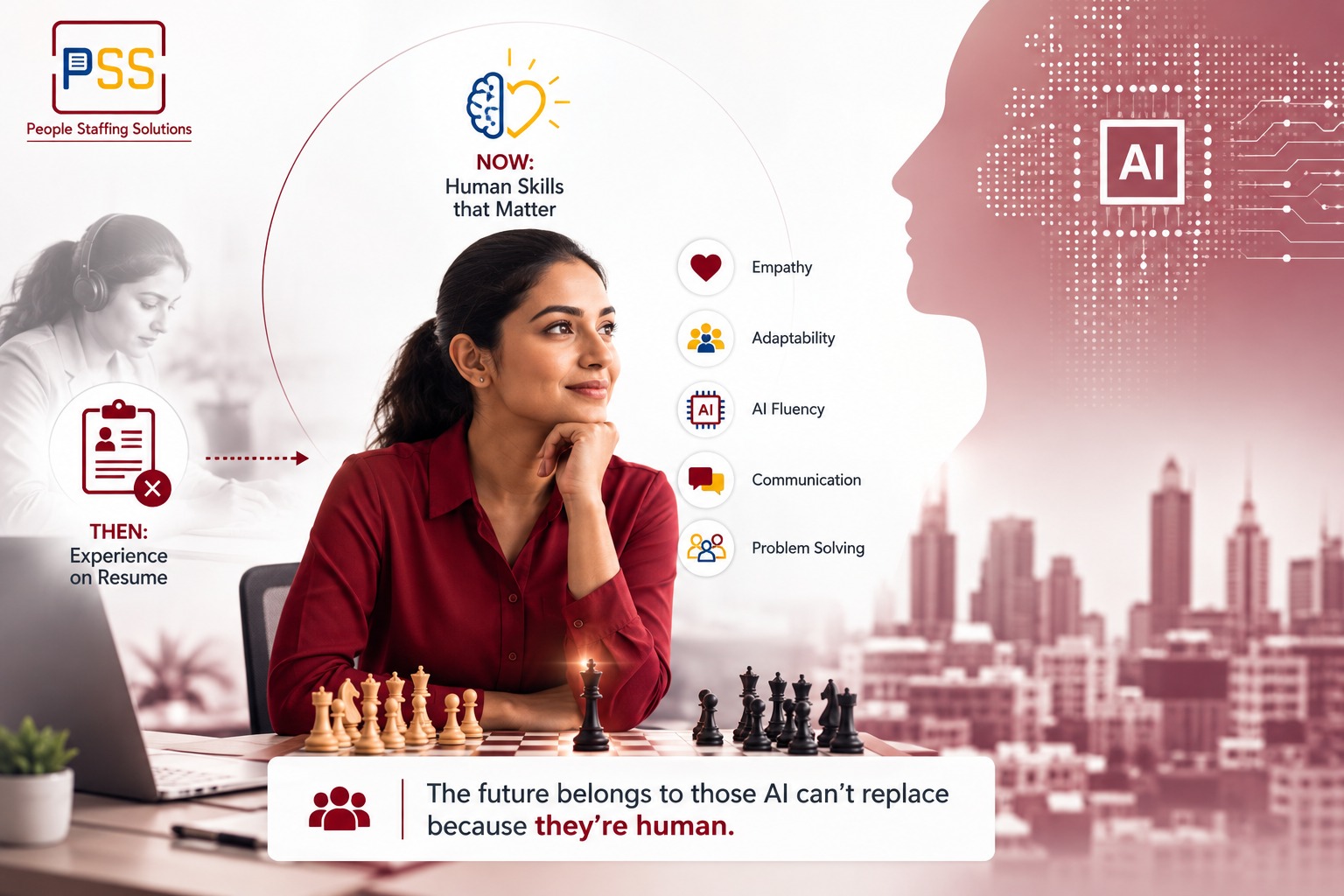
  • Experience is losing ground to empathy, adaptability, and AI fluency — traits that don’t show up on a resume the way “3 years BPO experience” does, but matter far more once AI has already handled everything routine.
  • The talent pool is widening — employers are hiring people who’d have been overlooked under the old experience-first model, because the job no longer rewards someone who follows a script well. It rewards someone AI can’t replace.
  • Multilingual support and omnichannel fluency are now the default expectation, not a specialization.
  • The industry is splitting into two tiers — commoditized support work, and high-value, specialized CX work (BFSI, healthcare, technical support) that pays and grows very differently.
Woman sitting at a desk with a chess board, with icons listing human skills like empathy, adaptability, AI fluency, communication, and problem solving, contrasted with a crossed-out resume icon labeled experience
The new hiring currency: empathy, adaptability, and AI fluency over years on a resume

How People Work Is Changing Too

  • Hybrid is now the standard operating model, not a pandemic-era exception — and it’s proving to reduce turnover, not just improve morale.
  • Gig and flexible shift models are expanding, opening the door to caregivers, students, and talent that traditional fixed-shift roles used to exclude entirely.
  • Retention is now a tracked KPI, not an accepted cost of doing business.

What This Means for Us

This is a hiring market rewarding precision, not headcount — and that’s exactly where the opportunity sits for us.

Glowing doorway with heart, scale, and people icons at the center of a white maze, symbolizing human connection as the future of the BPO industry
AI clears the path — but human judgment is what leads the way

Three things worth acting on:

  • Lead with the real story, not the fear narrative. Clients evaluating BPO partners are still operating on the outdated assumption that AI is shrinking this industry. We should be the ones correcting that — with data, not reassurance.
  • Build dual-track sourcing strength. The market needs strong fresher pipelines and senior specialist hiring simultaneously. Most competitors are still built for one or the other.
  • Treat retention and wellbeing as a service line, not a footnote. As turnover becomes a tracked KPI for clients, our ability to advise on retention — not just fill roles — becomes a genuine differentiator.

The BPO industry isn’t fading — it’s getting more human. AI took the scripts. It left the parts of the job that were always the hardest to automate in the first place: judgment, empathy, and the ability to make someone feel heard. The firms that understand that shift first will own the best mandates in 2026.

We help organizations build high-performing BPO teams—from high-volume fresher hiring to specialized CX leadership roles. If you’re preparing your hiring strategy for 2026, let’s discuss how data-driven recruitment can give your business a competitive edge.

Let’s connect for a Strategic Discussion!

Your 3% Hiring Growth Number Is Hiding a Talent Crisis

The Headline Number Is Lying to You: What’s Really Happening in India’s 2026 IT Hiring Market

Iceberg illustrating hidden depth beneath India's 2026 IT hiring headline growth number

If you’ve seen the topline figure — India’s IT hiring growing a modest 3% year-on-year — you might assume 2026 is a cautious, business-as-usual year for tech talent. That number is technically true and strategically misleading.

Beneath that modest headline, hiring has quietly split in two. AI, cloud, and cybersecurity roles now make up nearly two-thirds of all tech hiring demand. AI-first roles alone account for almost a third of new demand. At the same time, legacy roles — QA, IT support, routine testing — are shrinking as automation absorbs the work.

Companies aren’t hiring less. They’re hiring for a completely different skill set, at a completely different pace, than they were even 18 months ago.

Donut chart showing 90 percent of GenAI-ready tech talent gap in India for 2026
The GenAI talent gap is a cliff, not a gap — 9 in 10 roles can’t be filled today.

The Three Shifts Separating Winners From the Ones Who’ll Find Out Later

  1. The Back Office Just Became the Front Line Global Capability Centres now account for nearly 44% of India’s IT hiring, up sharply from last year, and they’re increasingly hiring for senior, specialized, global-facing roles — not support functions. If GCCs aren’t central to your talent strategy, you’re competing for a shrinking share of the best talent.
  2. The Skill Gap Isn’t a Gap Anymore. It’s a Cliff. Talent ready for generative AI work is in such short supply that roughly 9 in 10 qualified candidates simply don’t exist yet. Cloud and cybersecurity gaps aren’t far behind. This isn’t a recruiting inconvenience — it’s a constraint on how fast any strategy can actually execute.
  3. Your Company Is Hiring and Shrinking at the Same Time — And That’s the Point While companies aggressively hire for AI and cloud talent, they’re simultaneously trimming legacy roles automation has made redundant — sometimes in the same quarter, inside the same organization. Hundreds of thousands of mid-career roles are expected to be restructured industry-wide by 2028. Businesses that treat hiring and restructuring as separate processes will fall behind the ones treating it as one continuous rebalancing act.
Chart showing companies simultaneously hiring AI and cloud talent while restructuring 400000 to 500000 legacy roles by 2028
The same-quarter paradox — hiring and shrinking at once.


There’s a geography shift underneath all of this too — growth is moving toward GCC-heavy hubs and Tier II cities, while some traditional metro markets are actually contracting. Talent sourcing strategies built purely around the old metro playbook are already losing ground.


Stop Hiring for Roles. Start Investing in Capability.

The organizations getting this right have stopped asking “do we need to hire for this role” and started asking “what’s the smartest way to acquire this capability.”

That means treating talent like a portfolio, with four levers:

  • Build — invest in reskilling for capabilities core to your edge, especially where external hiring means competing in an overheated market.
  • Buy — hire externally only where speed matters more than cost, and where the skill is too scarce to build in time.
  • Borrow — use contract and flexible talent for emerging or uncertain needs. This model is growing fast for a reason.
  • Automate — for roles already shrinking, treat automation as a deliberate strategy, not a reaction.
Talent portfolio framework diagram showing build, buy, borrow, and automate hiring strategies
The Talent Portfolio Framework — four levers for smarter talent acquisition.

The businesses winning right now aren’t the ones hiring the most. They’re the ones using the right lever for the right capability, and revisiting that mix constantly instead of once a year.


The Opening We Can’t Afford to Miss

This shift isn’t a passing trend — it’s a structural rewrite of how talent gets built, bought, and deployed. And it creates a real opening for us.

Three things we need to get ahead of:

  • Precision over volume. Clients don’t need help filling more seats — they need help identifying exactly which capability gap is costing them the most, and solving that first. Our value has to be diagnostic, not just transactional.
  • GCC and Tier II expertise as a differentiator. As hiring concentrates around GCCs and emerging city hubs, firms with genuine depth in these markets will out-position generalist competitors fast. This is where we should be building our sharpest capability.
  • A talent-portfolio offering, not just a hiring service. Clients are going to need help thinking across build, buy, borrow, and automate — not just executing one of those levers. The consultancies who can advise on the mix, not just fill the roles, will own the highest-value conversations in this market.
Three strategic hiring priorities for 2026 — precision over volume, GCC and Tier II depth, talent portfolio offering
Three things we need to get ahead of in 2026’s talent market.


The CXOs who move on this now will be the ones defining the next five years of their industries. Our job is to make sure we’re the ones helping them get there first.

GCC Hiring in India 2026: Why the Talent Pipeline Is Failing the Growth Mandate

“We have the mandate. We have the budget. We have the headcount approval. What we do not have — is the candidate.”

Across India’s Global Capability Center (GCC) ecosystem, this statement has become increasingly familiar. Not inside struggling organisations. Inside some of the fastest-growing GCCs in the Country

India’s GCC Boom Has a Hidden Problem: Talent Access

According to industry reports by Business Standards & Times, India now hosts more than 2,100 GCCs employing over 2.36 million professionals, and AI sits at the centre of nearly every major expansion agenda. Investment remains strong. Executive sponsorship remains strong. Demand remains strong.

Yet one constraint continues to slow execution: Talent Access.

This is often described as a recruitment challenge. In reality, it is becoming a business challenge. The issue is not the availability of talent in absolute terms — India continues to produce one of the world’s largest technology workforces. The issue is access to the specific capabilities required to execute today’s AI, data, product, and digital transformation mandates.

Many GCC hiring models were built for a market where talent discovery was relatively straightforward, hiring cycles were less competitive, and speed carried limited strategic consequence. That market no longer exists.

The organisations consistently outperforming their peers are not necessarily investing more aggressively in GCC talent acquisition. They are operating with a more sophisticated understanding of how talent moves, where talent concentrates, and how access is created before demand becomes visible.

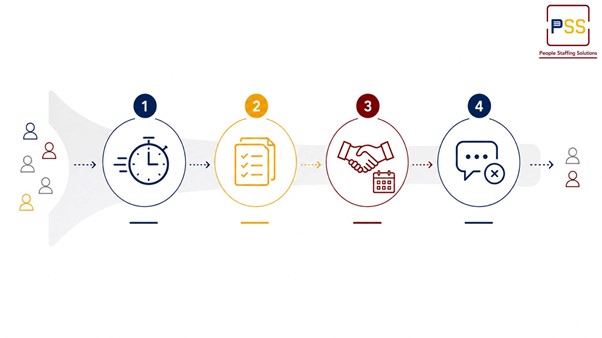
Based on our work across India’s GCC ecosystem, seven structural fault lines continue to shape GCC hiring outcomes in India.

Article content

7 Structural Fault Lines Shaping GCC Hiring Outcomes in India

1. Talent Concentration — Everyone Is Fishing in the Same Pond

Everyone is searching for GCC talent. Everyone is searching in the same place.

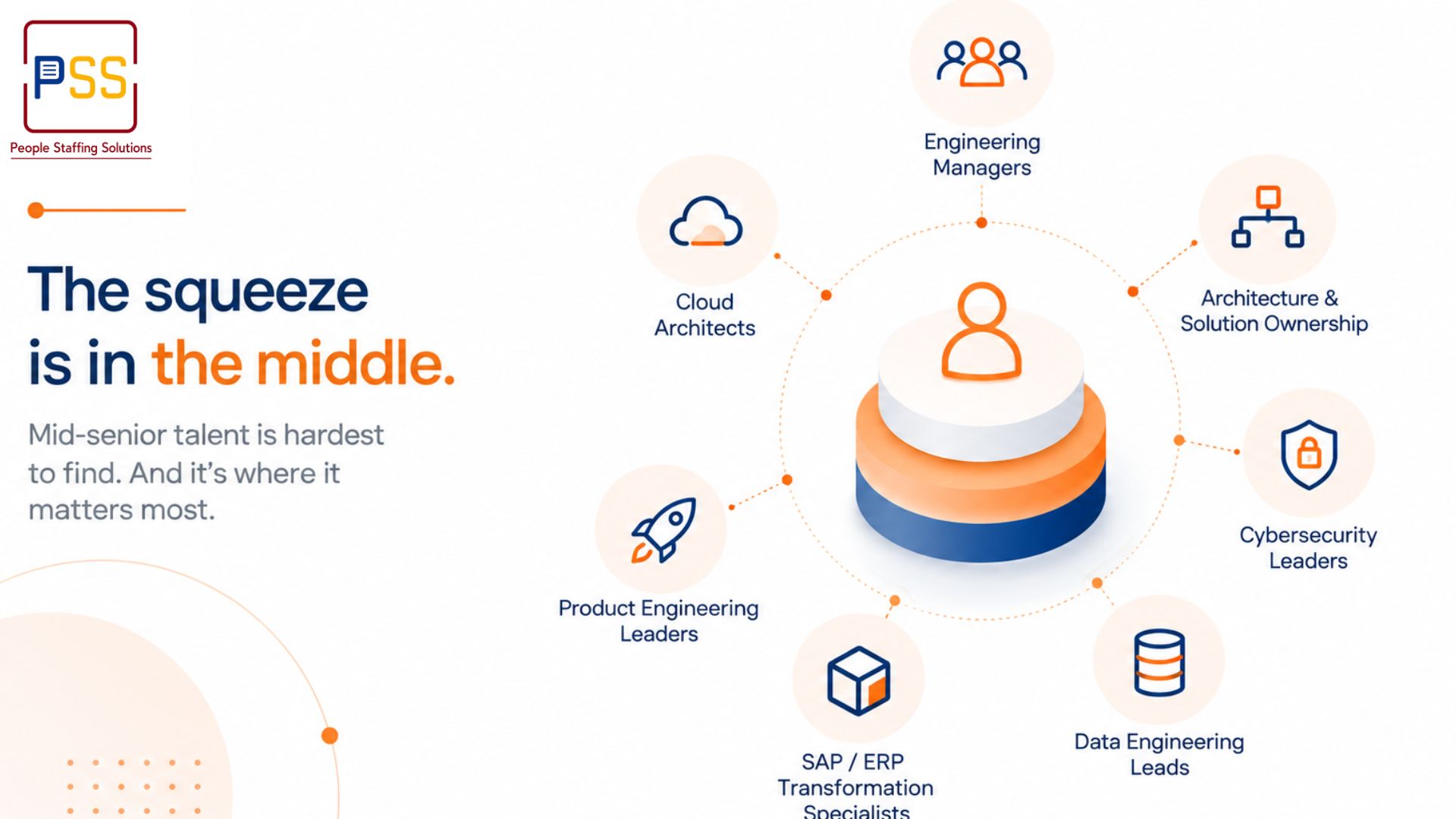
Demand for GenAI, MLOps, Machine Learning, Applied AI, and AI Product leadership continues to accelerate across India’s GCC ecosystem. Supply, however, remains highly concentrated.

The challenge is not a shortage of professionals entering the market. The challenge is that the most relevant professionals frequently appear on the same shortlists, receive approaches from the same organisations, and become the focus of the same competitive GCC hiring activity. The result is predictable: every new mandate enters an already crowded battlefield.

2. Passive Talent — The Best Candidates Are Not Applying

The majority of strategic GCC talent never enters the market.

The professionals most organisations want to hire are often the least likely to apply. Many GCC hiring strategies remain dependent on active job seekers, despite the reality that senior and high-performing professionals typically move through trusted networks, targeted conversations, and relationship-led engagement rather than public applications.

This creates a structural visibility gap. Organisations often compete intensely for the most visible talent while remaining disconnected from the largest segment of the market.

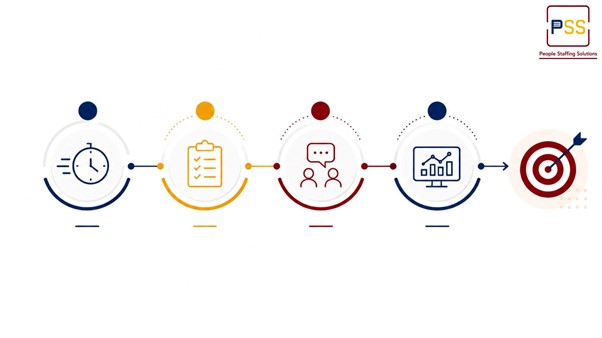
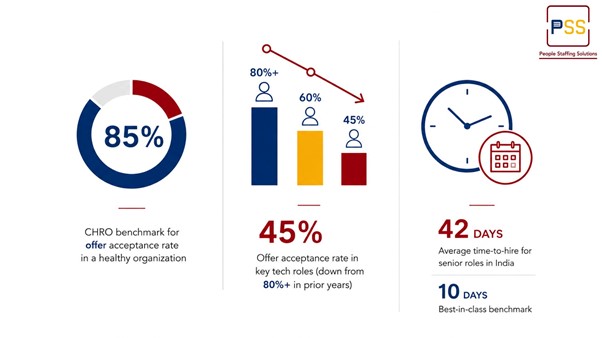
3. Time-to-Hire — 42 Days Is Too Long in a Competitive Market

In a competitive GCC hiring market, speed becomes a strategic capability.

For many specialised GCC technology roles, hiring cycles often extend beyond 40 days. For highly sought-after AI and digital professionals, that timeline can represent multiple competing interview processes, several offer discussions, and a completed hiring decision elsewhere.

What appears internally as a reasonable process often appears externally as hesitation. In today’s GCC talent market, delay creates risk.

4. Offer-Stage Attrition — Candidates Decide Before the Offer

Most offer declines in GCC hiring begin long before the offer is made.

Offer acceptance is often treated as a compensation discussion. In reality, it is frequently the outcome of a much earlier decision process. Candidates typically build conviction through engagement, trust, responsiveness, and clarity throughout the hiring journey. By the time multiple offers arrive, preference has often already formed.

The organisation that starts the relationship earliest frequently gains the advantage.

5. Geographic Expansion — Talent Infrastructure Lags Business Growth

GCC talent strategy cannot lag business expansion.

The next phase of GCC growth in India is increasingly extending beyond traditional hubs like Bengaluru, Hyderabad, and Pune into emerging capability centres such as Chennai, Coimbatore, Kochi, Nagpur, and similar Tier-2 markets.

While the talent opportunity is significant, talent access infrastructure often develops more slowly than business investment. Many organisations discover this gap only after GCC expansion plans are already underway.

6. Compensation Intelligence — Your Benchmarks Are Already Outdated

Market intelligence for GCC hiring ages faster than most organisations realise.

AI compensation structures have evolved more rapidly during the past eighteen months than during many previous hiring cycles combined. The challenge extends beyond salary benchmarks. Understanding talent movement, competitor hiring activity, capability migration, and market sentiment increasingly influences GCC hiring success as much as compensation itself.

Organisations operating on outdated intelligence often enter negotiations at a disadvantage before discussions even begin.

7. Scale vs. Specialisation — Two Goals, Two Different Hiring Models

Most GCCs in India are pursuing two objectives simultaneously:

•        Expanding workforce scale

•        Deepening capability sophistication

These are fundamentally different GCC talent challenges. The mechanisms required to hire hundreds of professionals efficiently are rarely the same mechanisms required to secure niche AI leaders, product specialists, or transformation executives.

Many organisations compensate by managing multiple recruitment partners, increasing complexity and reducing consistency.

Article content

The Strategic Reality: GCC Talent Access Is Now a Business Issue

The organisations leading India’s next phase of AI-driven GCC growth are not necessarily those with the largest hiring budgets. They are the organisations that understand talent access as a competitive capability.

As AI becomes increasingly central to enterprise transformation, GCC talent is no longer simply a workforce issue. It is an execution issue. A growth issue. A market-share issue.

•        Every delayed GCC hire delays capability creation.

•        Every lost candidate strengthens a competitor.

•        Every hiring decision now carries consequences beyond recruitment

How People Staffing Solutions Helps GCCs Remove Talent Constraints

At People Staffing Solutions, our focus has always been on the segments where GCC talent access is hardest, competition is highest, and business impact is greatest.

We help GCC TA teams build predictable talent access through market intelligence, passive talent networks, and specialised hiring execution. We remove the talent constraints that limit growth — whether that means accessing passive talent networks, compressing time-to-hire, providing real-time compensation intelligence, or managing both volume hiring and executive search simultaneously.

With over 15 years of experience, our GCC Hiring Intelligence Covers GCC setup hiring, Expansion hiring, Leadership hiring, AI/Data/Cloud/Product hiring, Volume engineering hiring along with Location strategy across BFSI, Technology, Healthcare, and Digital Transformation – we bring the market intelligence and network depth that GCC hiring demands in 2026.

📞If your GCC hiring mandate is outpacing your talent pipeline, let’s talk. → Contact us at – dipti.jha@peoplestaffing.in


If you thought India’s hiring scene peaked in 2024, think again — 2026 is about to rewrite the rulebook.

India’s talent landscape is shifting at lightning speed. As businesses invest heavily in AI, automation, sustainability, and global expansion, five sectors stand out as the epicenters of explosive hiring growth.


Here’s a structured view of the Top 5 Hiring Sectors in India for 2026 — curated by People Staffing Solutions.

1️⃣ Technology & AI Engineering

The Unstoppable Leader

The Engine:

  • AI adoption across all industries
  • Digital transformation across enterprises
  • Investment in cybersecurity, cloud, and automation
  • India’s ambition to become a global AI hub

Talent Hotspots:

  • AI/ML Engineers
  • Data Scientists
  • Cloud Architects
  • Cybersecurity Analysts
  • Full-Stack Developers

The Big Idea:

Tech is the foundation of every modern business. Companies are scaling tech teams 2–3x faster than previous years.


2️⃣ Healthcare & Life Sciences

A Sector With Nationwide Demand

The Engine:

  • Hospital and diagnostics expansion
  • Pharma and biotech innovation
  • Rise of telemedicine and digital health
  • Increased healthcare investment

Talent Hotspots:

  • Medical Practitioners & Nurses
  • Clinical Researchers
  • Pharma Manufacturing Experts
  • Biotechnology Specialists
  • Health Data Analysts

The Big Idea:

Healthcare is shifting toward digital, data-driven, personalized care.


3️⃣ E-Commerce & Supply Chain

The Backbone of India’s Consumer Economy

The Engine:

  • E-commerce to cross $200B+
  • Warehousing and last-mile expansion
  • Growth of logistics tech
  • Tier-2 and Tier-3 cities driving demand

Talent Hotspots:

  • Supply Chain Managers
  • Warehouse Operations Leads
  • Inventory Controllers
  • Digital Commerce Managers
  • Delivery Executives

The Big Idea:

Logistics and operations talent is becoming mission-critical as digital buying expands nationwide.


4️⃣ Green Energy & Sustainability

India’s Transition Toward a Greener Future

The Engine:

  • Solar, wind, and EV expansion
  • Corporate sustainability mandates
  • Government incentives for green energy
  • Renewable energy targets rising

Talent Hotspots:

  • Solar Project Engineers
  • EV Technicians
  • Energy Analysts
  • Sustainability Officers
  • Carbon Accounting Experts

The Big Idea:

Green energy is a national hiring priority and one of India’s fastest-growing job creators.


5️⃣ BFSI & FinTech

The Financial Revolution Continues

The Engine:

  • Expansion of digital banking and UPI
  • Rise of neobanks and wealth-tech
  • AI-driven lending and financial automation
  • Strong compliance and regulatory frameworks

Talent Hotspots:

  • Financial Analysts
  • Risk & Compliance Officers
  • Product Managers
  • Relationship Managers
  • Blockchain Specialists

The Big Idea:

BFSI is now deeply digital — blending finance expertise with technology skills.


📌 People Staffing Solutions Takeaway

2026 will be defined by digital-first, skill-focused hiring. Companies want impact-driven roles that accelerate transformation and build long-term capabilities.

For Talent Leaders:

  • Build future-skill pipelines in AI, supply chain, compliance, and sustainability
  • Invest in upskilling
  • Shift hiring from volume to strategic capability building

For Job Seekers:

  • Select a growth sector
  • Upskill in digital tools and AI-driven technologies
  • Strengthen adaptability, analytics, and problem-solving


India’s job market isn’t slowing — it’s accelerating. The next leap belongs to those who prepare today.

Breaking Barriers: Fostering Diversity, Equity & Inclusion in the Workplace

Diversity and Inclusion (D&I) are not merely corporate buzzwords but essential pillars that underpin a progressive and innovative workplace. The essence of D&I lies in creating an environment that is equitable and fosters a sense of belonging for individuals from diverse backgrounds.


  1. Purpose of Diversity and Inclusion in Modern Workplace


By valuing and integrating a mosaic of perspectives, companies cultivate a culture rich in ideas, leading to superior decision-making, enhanced creativity, and ultimately, robust business outcomes. This commitment to diversity translates into a dynamic workforce where every voice is heard and valued, paving the way for sustained innovation and success.


  1. Benefits of D&I and the Importance of an Inclusive Culture


The advantages of D&I extend far beyond the realms of fairness and ethical responsibility. It is a formidable strategic asset that can propel organizations to new heights. Inclusive cultures are fertile grounds for a plethora of ideas, driving better problem-solving and breakthrough innovations. The tangible benefits are evident in increased employee engagement, higher retention rates, and amplified business performance. When employees feel included and appreciated, their commitment and productivity soar, fostering a thriving organizational ecosystem. An inclusive culture is not just a moral imperative but a catalyst for achieving unparalleled business success.


  1. Common Barriers to D&I


The journey to building a diverse and inclusive workplace is fraught with challenges. Unconscious biases can insidiously influence hiring decisions, while a lack of diverse leadership can deter potential talent. Ineffectively implemented policies often fail to shift ingrained mindsets. Additionally, varying communication styles can erect barriers to inclusivity. Overcoming these obstacles requires a sustained and multifaceted approach:

  1. Continuous education for employees
  2. Transparent pathways for career advancement
  • A culture that champions open communication and celebrates diversity.

Addressing these barriers is crucial to fostering a truly inclusive environment where every individual can thrive.


  1. The Changing Trend


The contemporary workplace is increasingly embracing D&I, and for compelling reasons: it drives business success. Diverse teams are synonymous with fresh perspectives and superior problem-solving capabilities, catalyzing innovation and yielding stronger results. As the workforce itself becomes more diverse, companies must reflect this evolution to attract and retain top-tier talent. This alignment with the values of a new generation not only enhances a company’s appeal but also positions it competitively in the marketplace. D&I is not just a moral or ethical consideration but a strategic necessity in the modern business landscape.


  1. Recruitment Firms: Pioneers in Advancing D&I


Recruitment firms stand at the vanguard of advancing D&I initiatives. They play a pivotal role in broadening the talent pool by targeting diverse channels and organizations. Implementing standardized interviews, involving diverse hiring panels, and training stakeholders on unconscious bias are critical measures to ensure fairness in the hiring process. By tracking data and advocating for transparency, recruitment firms can identify and rectify biases that may impede progress. They act as vital conduits, bridging the gap between companies and a more diverse, qualified workforce. In essence, recruitment firms are instrumental in fostering an inclusive hiring process that champions diversity and cultivates excellence.


Summary / Conclusion


In conclusion, embracing D&I is not a mere trend but an essential strategy for sustainable growth and innovation. By confronting barriers and leveraging the expertise of recruitment firms, organizations can cultivate a workforce that is as diverse as it is dynamic. This strategic embrace of D&I is the pathway to creating a workplace where every individual can contribute to and share in the collective success.

Title: Navigating Team Success: The Crucial Role of Role Clarity

In the dynamic landscape of modern workplaces, where collaboration and synergy reign supreme, the importance of role clarity within a team cannot be overstated. When each team member understands their role, responsibilities, and contributions, the collective potential of the team is unleashed, paving the way for success. In this blog post, we’ll explore the significance of role clarity and how it serves as a cornerstone for achieving team goals.

Understanding Role Clarity: A Foundation for Success

Role clarity is the degree to which team members have a clear understanding of their roles, the roles of their peers, and how these roles contribute to the overall objectives of the team. It goes beyond merely defining job titles; it involves a comprehensive comprehension of individual responsibilities, expectations, and the interdependencies that exist within the team structure.

 The Impact on Team Dynamics

  1. Enhanced Productivity: When team members are aware of their roles, tasks are executed more efficiently. There is no ambiguity regarding who is responsible for what, reducing the likelihood of tasks slipping through the cracks.
  2. Improved Collaboration: Role clarity fosters collaboration by creating a framework in which team members can leverage each other’s strengths. Understanding the complementary nature of roles encourages communication and cooperation.
  3. Boosted Morale and Motivation: Knowing that their contributions matter and are integral to the team’s success can significantly boost individual morale. This sense of purpose translates into increased motivation to excel in one’s role.

Challenges of Ambiguity

Conversely, a lack of role clarity can lead to several challenges that hinder team success:

  1. Duplication of Effort: Without clear roles, team members might inadvertently duplicate tasks, leading to wasted time and resources.
  2. Conflict and Frustration: Ambiguity can breed conflict, as team members may clash over responsibilities and expectations. This can create a tense working environment that negatively impacts team morale.
  3. Missed Opportunities: When team members are unsure of their roles, they may miss opportunities to leverage their skills and expertise effectively. This can result in untapped potential that could benefit the team’s overall performance.

 Strategies for Establishing Role Clarity

  1. Clearly Defined Job Descriptions: Begin with clear, detailed job descriptions for each team member. Outline responsibilities, expectations, and key performance indicators to set a solid foundation for role clarity.
  2. Regular Communication: Foster an environment of open communication. Regular team meetings, one-on-one check-ins, and clear channels for communication can help address any uncertainties and ensure everyone is on the same page.
  3. Encourage Questions and Feedback: Create a culture where team members feel comfortable seeking clarification and providing feedback. This not only promotes role clarity but also contributes to continuous improvement.

Conclusion: Empowering Teams Through Clarity

In the ever-evolving landscape of team dynamics, role clarity stands as a linchpin for success. Teams that invest time and effort in defining and communicating roles are better equipped to navigate challenges, capitalize on opportunities, and achieve their goals. As leaders and team members alike recognize the profound impact of role clarity, it becomes a shared responsibility to cultivate an environment where everyone knows their role and the collective potential of the team is fully realized.

Interview Success: Mastering Common Questions and Techniques

In the fast-paced and competitive job market, the key to securing your dream job often lies in your ability to navigate the interview successfully. While every interview is unique, there are common questions and techniques that recur across industries. Mastering these can significantly enhance your chances of impressing prospective employers and standing out from the crowd.

  1. Know Your Story: Crafting a Compelling Narrative

One of the most frequently asked questions in interviews is the classic “Tell me about yourself.” While seemingly simple, this question serves as an opportunity for you to showcase your professional journey. Craft a concise and compelling narrative that highlights your relevant experiences, skills, and achievements. Emphasize how your background aligns with the position you’re interviewing for, providing a strong introduction that sets a positive tone for the rest of the conversation.

  1. Strengths and Weaknesses: Turning Challenges into Opportunities

Another common line of inquiry revolves around your strengths and weaknesses. When discussing strengths, focus on those that are directly applicable to the job at hand. Support your claims with specific examples from your past experiences. On the flip side, when addressing weaknesses, emphasize your commitment to self-improvement. Discuss how you’ve actively worked to overcome challenges, turning them into opportunities for personal and professional growth.

  1. Behavioural Questions: STAR Technique

Behavioural questions are designed to assess how you’ve handled situations in the past, providing insights into your problem-solving abilities and interpersonal skills. The STAR technique (Situation, Task, Action, Result) is a powerful tool for structuring your responses to such questions. Start by describing the situation, outline the tasks involved, explain the actions you took, and conclude by highlighting the positive results of your efforts.

  1. Research the Company: Showcase Your Interest and Preparedness

Demonstrate your commitment to the prospective employer by conducting thorough research on the company. Familiarize yourself with its mission, values, and recent achievements. When asked, “Why do you want to work for this company?” or “What do you know about us?” your well-informed responses will underscore your genuine interest and preparedness. This knowledge not only showcases your enthusiasm but also helps you tailor your answers to align with the company’s goals and values.

  1. Teamwork and Collaboration: Highlighting Your Interpersonal Skills

Employers often inquire about your ability to work in a team. Be ready to share instances where you collaborated effectively with colleagues, resolved conflicts, or contributed to the success of group projects. Emphasize your communication skills, adaptability, and openness to diverse perspectives. Illustrating your positive impact on team dynamics can set you apart as a candidate who not only excels individually but also contributes to a harmonious work environment.


  1. Questions for the Interviewer: Demonstrating Your Interest

Toward the end of the interview, you’ll likely be given the opportunity to ask questions. Prepare insightful queries that showcase your genuine interest in the company and the role. Ask about the team dynamics, future projects, or the company’s approach to professional development. This not only demonstrates your enthusiasm but also provides valuable information for your decision-making process.

 Conclusion: Confidence and Preparation are Key

In conclusion, interview success is a combination of confidence and thorough preparation. By anticipating common questions and mastering effective techniques, you can navigate interviews with poise and authenticity. Remember to tailor your responses to showcase your unique strengths and experiences, creating a lasting impression on the interviewer. Continuous refinement of your interview skills, coupled with a genuine passion for the role and company, will undoubtedly propel you toward achieving success in your job search. Good luck!

Building Your Dream Team: A Guide to Creating the Best Recruitment Team

In the fast-paced and competitive business landscape, having a stellar recruitment team is paramount for the success and growth of any organization. A team that excels in finding, attracting, and retaining top talent can be a game-changer. In this blog post, we’ll explore key strategies to create the best recruitment team that will drive your company’s success.


  1. Define Clear Objectives:

Before assembling your recruitment team, clearly define your hiring objectives. Understand the skills, qualities, and cultural fit you’re looking for in candidates. Having a well-defined strategy will guide your team’s efforts and ensure everyone is on the same page.


  1. Diverse Skill Sets:

A successful recruitment team is one that brings diverse skill sets to the table. Consider including individuals with expertise in sourcing, interviewing, employer branding, and data analytics. A mix of skills ensures a holistic approach to the recruitment process.


  1. Effective Communication:

Communication is key in any team, but especially in recruitment. Foster an environment where open and transparent communication is encouraged. This includes regular team meetings, constructive feedback sessions, and a shared understanding of team goals.


  1. Leverage Technology:

Stay ahead in the recruitment game by incorporating cutting-edge technology. Applicant tracking systems, AI-powered screening tools, and data analytics can streamline the hiring process, saving time and resources while improving the quality of hires.


  1. Continuous Training:

The recruitment landscape is dynamic, with trends and techniques evolving rapidly. Ensure your team stays ahead by providing continuous training. This can include workshops, webinars, and access to relevant industry conferences.


  1. Build a Strong Employer Brand:

A compelling employer brand attracts top talent. Work collaboratively with your marketing team to highlight your company’s unique culture, values, and opportunities. An attractive employer brand not only lures in great candidates but also makes your team’s job easier.


  1. Data-Driven Decision Making:

Utilize data analytics to make informed decisions. Track key metrics such as time-to-fill, cost-per-hire, and candidate satisfaction. Analyzing data can help your team identify areas for improvement and optimize the recruitment process.


  1. Collaborate with Hiring Managers:

Foster strong relationships with hiring managers. Regularly communicate to understand their needs and expectations. This collaboration ensures that your recruitment team is aligned with the overall goals of the organization.


  1. Create a Positive Candidate Experience:

The candidate experience reflects on your company’s brand. Ensure that your team provides a positive and respectful experience for all candidates, whether they are successful or not. This contributes to a positive employer brand and may encourage rejected candidates to reapply in the future.


  1. Adaptability and Flexibility:

The ability to adapt to changing circumstances is crucial. Your team should be flexible enough to navigate unexpected challenges and adjust strategies accordingly. This adaptability ensures continued success in a dynamic job market.


In conclusion, building the best recruitment team requires a combination of strategic planning, diverse skills, effective communication, and a commitment to continuous improvement. By implementing these key strategies, you can create a team that not only meets but exceeds your hiring goals, contributing to the overall success and growth of your organization.

LinkedIn
WhatsApp
Twitter
Facebook
Instagram