The New Technology Talent Premium: What Skills Are Companies Actually Paying More For in 2026?
- August 27, 2026
The New Technology Talent Premium: What Skills Are Companies Actually Paying More For in 2026?
Most salary benchmarking answers one question: what does the market pay for a given skill? It rarely answers the more useful one: why does the market pay more for it. That second question is what actually helps a CXO decide where to spend budget, and where they’re overpaying for something that’s quietly become standard.
The Premium Stack
Not every in-demand skill commands a premium for the same reason. A few examples make the pattern clear:
- Actuarial and CAT modeling commands a premium because the domain knowledge required is extraordinarily narrow and hard to substitute — there is no large adjacent talent pool to draw from when demand spikes.
- AI and GenAI talent is priced on scarcity intersecting with visible business impact — everyone wants it, few can deliver it credibly, and leadership can see the outcome directly.
- Data engineering now carries a premium mainly because it’s the dependency everything else sits on — AI initiatives fail quietly without it, which makes it business-critical infrastructure rather than a support function.
- Cybersecurity is priced on risk and regulatory exposure — the cost of getting it wrong is asymmetric and highly visible when it fails.
- Cloud, DevOps, SAP/ERP, and Salesforce premiums track migration and transformation complexity — the skill is valuable specifically during periods of architectural change, less so once a system stabilizes.
- Product engineering, fintech, and healthcare technology premiums come from sitting at the intersection of deep domain knowledge and direct revenue or regulatory ownership — the technical skill alone isn’t what’s being paid for.

Why Actuarial and CAT Modeling Deserves Its Own Category
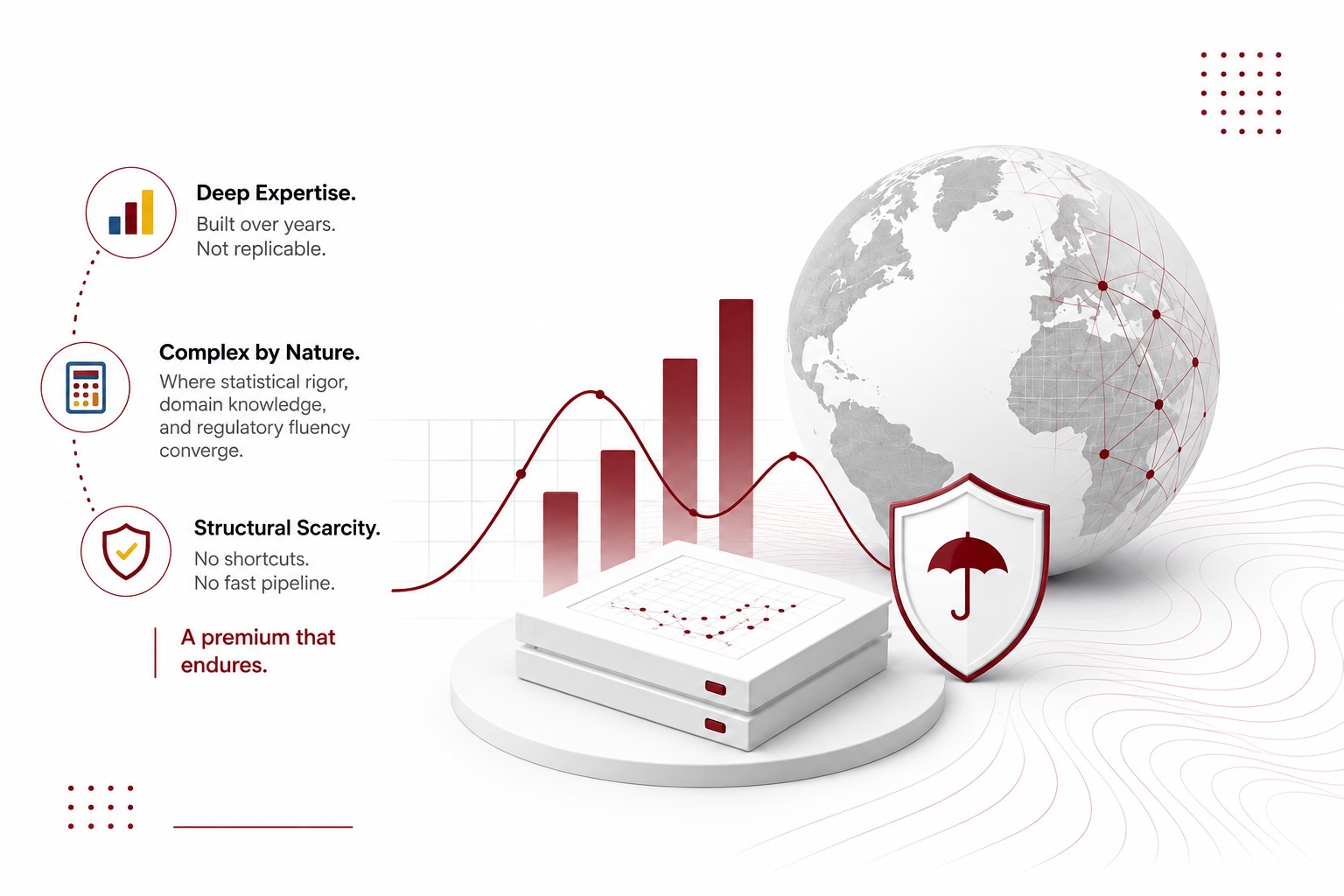
Most skills on this list command a premium because of scarcity relative to current demand. Actuarial and catastrophe modeling talent is different — it commands a premium because of scarcity relative to the complexity of the discipline itself. Building and validating catastrophe risk models requires a rare combination of statistical rigor, deep insurance and reinsurance domain knowledge, and regulatory fluency that takes years to develop and cannot be substituted with adjacent skills the way a software framework can be swapped for another. There is no fast pipeline for this talent — no bootcamp shortens the path. That makes it one of the few categories where the premium isn’t really about market timing at all. It’s structural, and it’s likely to stay that way regardless of how the broader tech hiring market moves.
What Actually Creates a Talent Premium
Strip away the specifics of any single skill category, and the same four factors keep showing up together wherever a genuine premium exists:
Technology — the raw technical skill, which is necessary but rarely sufficient on its own.
Domain — specialized knowledge of an industry or discipline that can’t be picked up quickly.
Experience — enough real-world exposure to apply judgment, not just execute a known pattern.
Business ownership — proximity to a decision that directly affects revenue, risk, or regulatory standing.
A premium tends to appear where at least three of these four stack together. Technology alone rarely commands one for long — it gets commoditized as the talent pool catches up. Technology plus domain plus ownership, as in actuarial modeling or fintech engineering, is far more durable.
The CXO Question That Actually Matters
The useful question isn’t “what should we pay for this skill.” It’s: which skills deserve a premium, and which have quietly become table stakes we’re still paying premium rates for?
Cloud fluency, for instance, commanded a steep premium a few years ago. Today, it’s closer to a baseline expectation for most engineering roles — the premium has migrated toward cloud architecture and migration complexity specifically, not cloud skills in general. The same drift happens across most of this list over time. A CXO who hasn’t re-examined compensation bands against this shift is very likely still paying yesterday’s premium for today’s baseline skill.

The Bottom Line
Salary benchmarking tells you what the market charges. Understanding the premium stack tells you whether that charge still makes sense. The skills worth paying above-market for are the ones where technology, domain depth, real experience, and business ownership genuinely compound — not just the ones that happen to be trending in a job board search.
Let’s connect for a Strategic Discussion!