GCC Hiring in India 2026: Why the Talent Pipeline Is Failing the Growth Mandate
- July 20, 2026
“We have the mandate. We have the budget. We have the headcount approval. What we do not have — is the candidate.”
Across India’s Global Capability Center (GCC) ecosystem, this statement has become increasingly familiar. Not inside struggling organisations. Inside some of the fastest-growing GCCs in the Country
India’s GCC Boom Has a Hidden Problem: Talent Access
According to industry reports by Business Standards & Times, India now hosts more than 2,100 GCCs employing over 2.36 million professionals, and AI sits at the centre of nearly every major expansion agenda. Investment remains strong. Executive sponsorship remains strong. Demand remains strong.
Yet one constraint continues to slow execution: Talent Access.
This is often described as a recruitment challenge. In reality, it is becoming a business challenge. The issue is not the availability of talent in absolute terms — India continues to produce one of the world’s largest technology workforces. The issue is access to the specific capabilities required to execute today’s AI, data, product, and digital transformation mandates.
Many GCC hiring models were built for a market where talent discovery was relatively straightforward, hiring cycles were less competitive, and speed carried limited strategic consequence. That market no longer exists.
The organisations consistently outperforming their peers are not necessarily investing more aggressively in GCC talent acquisition. They are operating with a more sophisticated understanding of how talent moves, where talent concentrates, and how access is created before demand becomes visible.
Based on our work across India’s GCC ecosystem, seven structural fault lines continue to shape GCC hiring outcomes in India.

7 Structural Fault Lines Shaping GCC Hiring Outcomes in India
1. Talent Concentration — Everyone Is Fishing in the Same Pond
Everyone is searching for GCC talent. Everyone is searching in the same place.
Demand for GenAI, MLOps, Machine Learning, Applied AI, and AI Product leadership continues to accelerate across India’s GCC ecosystem. Supply, however, remains highly concentrated.
The challenge is not a shortage of professionals entering the market. The challenge is that the most relevant professionals frequently appear on the same shortlists, receive approaches from the same organisations, and become the focus of the same competitive GCC hiring activity. The result is predictable: every new mandate enters an already crowded battlefield.
2. Passive Talent — The Best Candidates Are Not Applying
The majority of strategic GCC talent never enters the market.
The professionals most organisations want to hire are often the least likely to apply. Many GCC hiring strategies remain dependent on active job seekers, despite the reality that senior and high-performing professionals typically move through trusted networks, targeted conversations, and relationship-led engagement rather than public applications.
This creates a structural visibility gap. Organisations often compete intensely for the most visible talent while remaining disconnected from the largest segment of the market.
3. Time-to-Hire — 42 Days Is Too Long in a Competitive Market
In a competitive GCC hiring market, speed becomes a strategic capability.
For many specialised GCC technology roles, hiring cycles often extend beyond 40 days. For highly sought-after AI and digital professionals, that timeline can represent multiple competing interview processes, several offer discussions, and a completed hiring decision elsewhere.
What appears internally as a reasonable process often appears externally as hesitation. In today’s GCC talent market, delay creates risk.
4. Offer-Stage Attrition — Candidates Decide Before the Offer
Most offer declines in GCC hiring begin long before the offer is made.
Offer acceptance is often treated as a compensation discussion. In reality, it is frequently the outcome of a much earlier decision process. Candidates typically build conviction through engagement, trust, responsiveness, and clarity throughout the hiring journey. By the time multiple offers arrive, preference has often already formed.
The organisation that starts the relationship earliest frequently gains the advantage.
5. Geographic Expansion — Talent Infrastructure Lags Business Growth
GCC talent strategy cannot lag business expansion.
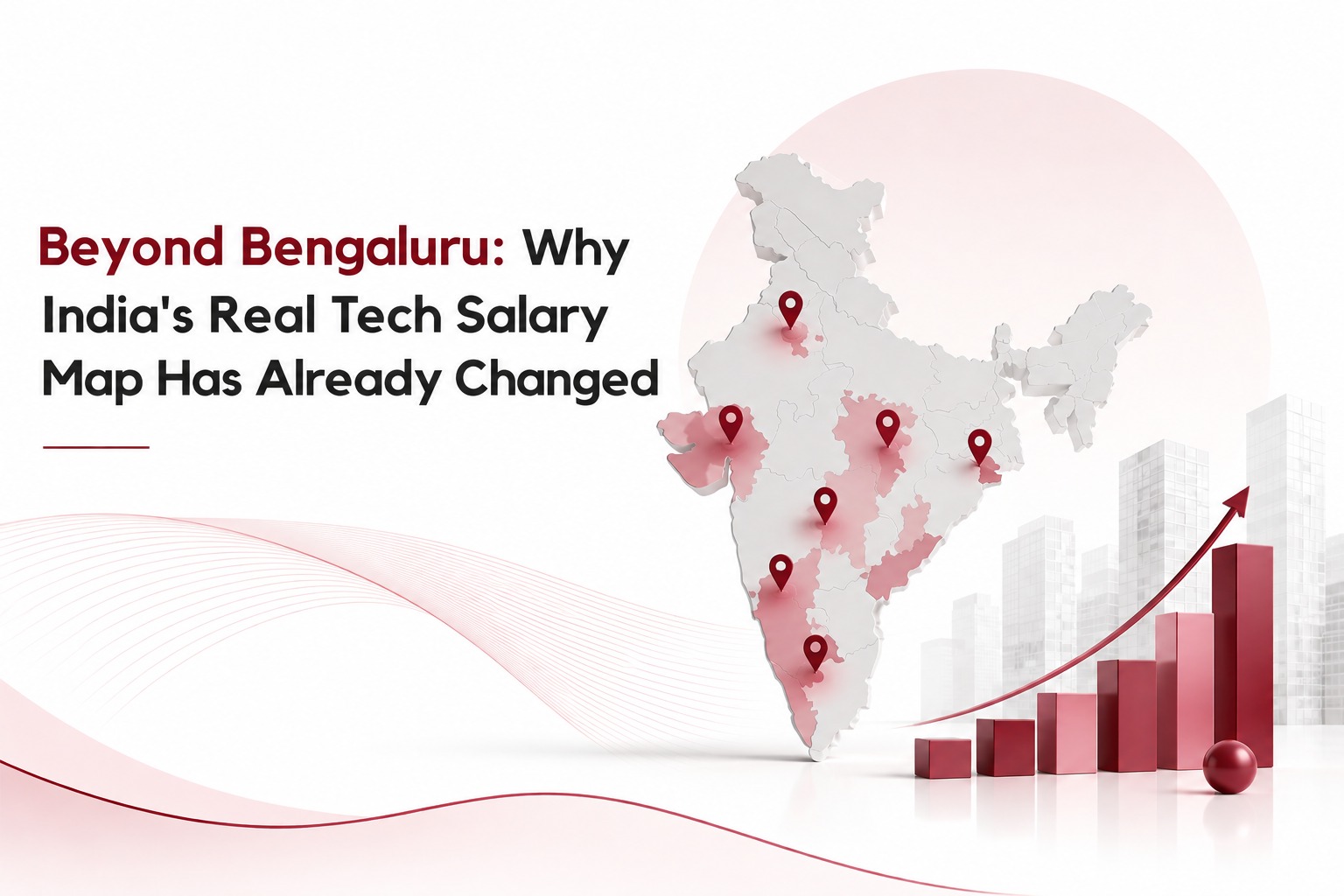
The next phase of GCC growth in India is increasingly extending beyond traditional hubs like Bengaluru, Hyderabad, and Pune into emerging capability centres such as Chennai, Coimbatore, Kochi, Nagpur, and similar Tier-2 markets.
While the talent opportunity is significant, talent access infrastructure often develops more slowly than business investment. Many organisations discover this gap only after GCC expansion plans are already underway.
6. Compensation Intelligence — Your Benchmarks Are Already Outdated
Market intelligence for GCC hiring ages faster than most organisations realise.
AI compensation structures have evolved more rapidly during the past eighteen months than during many previous hiring cycles combined. The challenge extends beyond salary benchmarks. Understanding talent movement, competitor hiring activity, capability migration, and market sentiment increasingly influences GCC hiring success as much as compensation itself.
Organisations operating on outdated intelligence often enter negotiations at a disadvantage before discussions even begin.
7. Scale vs. Specialisation — Two Goals, Two Different Hiring Models
Most GCCs in India are pursuing two objectives simultaneously:
• Expanding workforce scale
• Deepening capability sophistication
These are fundamentally different GCC talent challenges. The mechanisms required to hire hundreds of professionals efficiently are rarely the same mechanisms required to secure niche AI leaders, product specialists, or transformation executives.
Many organisations compensate by managing multiple recruitment partners, increasing complexity and reducing consistency.

The Strategic Reality: GCC Talent Access Is Now a Business Issue
The organisations leading India’s next phase of AI-driven GCC growth are not necessarily those with the largest hiring budgets. They are the organisations that understand talent access as a competitive capability.
As AI becomes increasingly central to enterprise transformation, GCC talent is no longer simply a workforce issue. It is an execution issue. A growth issue. A market-share issue.
• Every delayed GCC hire delays capability creation.
• Every lost candidate strengthens a competitor.
• Every hiring decision now carries consequences beyond recruitment
How People Staffing Solutions Helps GCCs Remove Talent Constraints
At People Staffing Solutions, our focus has always been on the segments where GCC talent access is hardest, competition is highest, and business impact is greatest.
We help GCC TA teams build predictable talent access through market intelligence, passive talent networks, and specialised hiring execution. We remove the talent constraints that limit growth — whether that means accessing passive talent networks, compressing time-to-hire, providing real-time compensation intelligence, or managing both volume hiring and executive search simultaneously.
With over 15 years of experience, our GCC Hiring Intelligence Covers GCC setup hiring, Expansion hiring, Leadership hiring, AI/Data/Cloud/Product hiring, Volume engineering hiring along with Location strategy across BFSI, Technology, Healthcare, and Digital Transformation – we bring the market intelligence and network depth that GCC hiring demands in 2026.
📞If your GCC hiring mandate is outpacing your talent pipeline, let’s talk. → Contact us at – dipti.jha@peoplestaffing.in
Let’s connect for a Strategic Discussion!