India’s Hiring Friction Index 2026: Where Candidates Drop Out — and What It Costs August 2026
- September 25, 2026
India’s Hiring Friction Index 2026: Where Candidates Drop Out — and What It Costs August 2026
An Accepted Offer Is Not a Closed Position
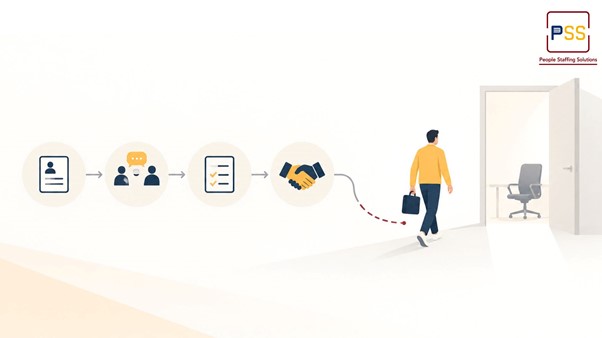
A candidate clears every round. The panel signs off. The offer goes out, and it’s accepted. On paper, the role is filled. In practice, nothing is guaranteed until that person is at their desk on day one — and in 2026, a growing share of “closed” roles in India are quietly reopening between acceptance and joining.
This is worth board-level attention for one reason: it isn’t a talent shortage. It’s leakage inside a process the organization already controls. That distinction matters, because a shortage requires a market fix. Leakage requires a management fix — and management fixes are faster, cheaper, and entirely within a CXO’s authority.
The Numbers Behind the Problem
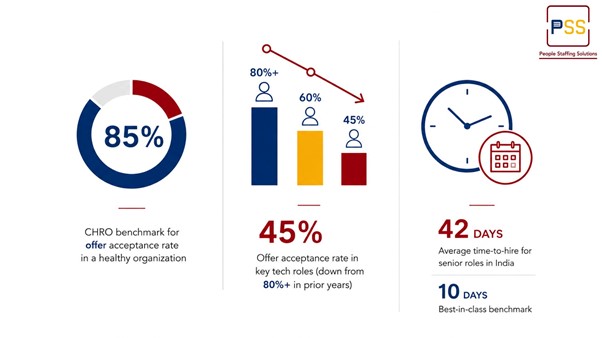
CHRO benchmarking treats an offer acceptance rate above 85% as the standard for a healthy Indian organization — a target that implies a meaningful share of companies are operating well under it today.
In specific technical functions, the gap is stark. Acceptance rates for roles like full-stack engineers, data engineers, and DevOps professionals have fallen to roughly 45% in parts of the market, down from over 80% in prior years, according to Xpheno data reported by ETHRWorld.
Time is the multiplier on all of this. Average time-to-hire for senior roles in India sits close to 42 days, against a best-in-class benchmark nearer 10. Every one of those extra days is a day a faster competitor has to reach the same candidate first — and in a tight senior talent market, they usually do.
Four Points of Failure, Not One
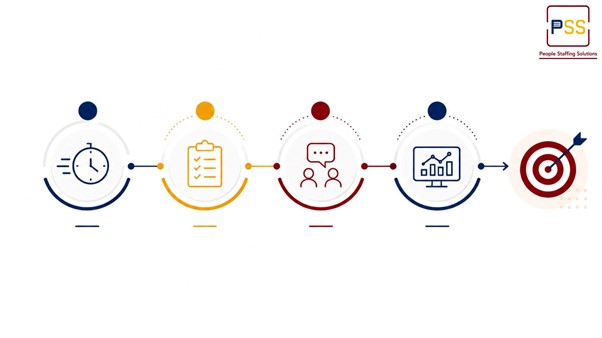
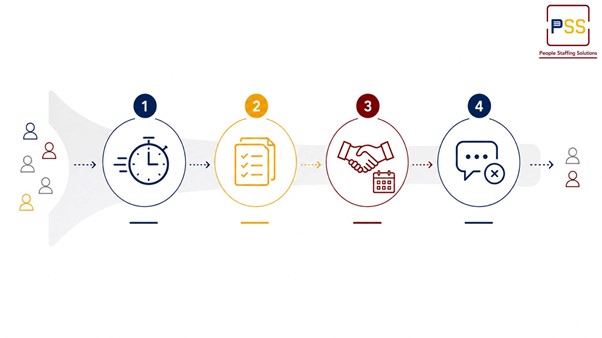
Leadership teams often treat drop-off as a single event — “the candidate ghosted us.” It’s rarely one event. It’s a funnel with four distinct failure points, each requiring a different owner and a different fix:
- Slow first contact. Days pass between application and outreach. The candidate is already mid-process elsewhere by the time your team calls.
- Screening that outlasts patience. Multi-round technical assignments before a candidate has met the team signal high effort for uncertain payoff — strong candidates opt out rather than push through.
- The accept-to-join gap. The single most expensive failure point. A candidate says yes, then spends the notice period absorbing a counteroffer or a competing offer that lands before their start date.
- Silence between rounds. No update reads as disinterest, whether or not it is — and the candidate re-engages elsewhere rather than wait for word.
Each of these is a management failure, not a market condition. That’s the reframe CXOs need: this is not a hiring problem to be outspent. It’s a process problem to be redesigned.
The Real Cost
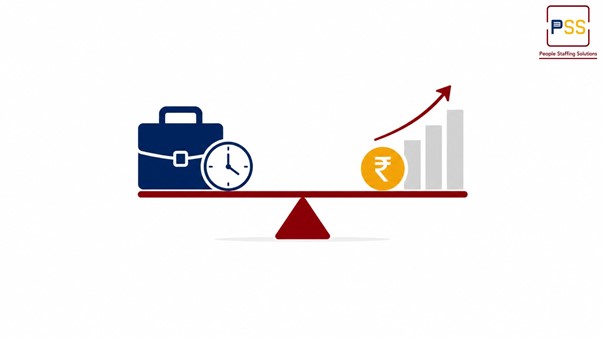
This isn’t a recruiting metric — it’s a capital allocation problem. A critical technical role sitting open in a fast-moving business routinely costs well into six figures a month in delayed delivery and missed timelines, independent of the salary that isn’t being paid
Get the replacement wrong under time pressure, and the cost compounds. A mismatched mid-senior hire in India typically costs several lakhs once recruitment fees, underperformance, and a restarted search are counted — considerably more at the senior level .
Slow hiring and rushed hiring are not two different problems. They are the same cost, arriving on different timelines.
An accepted offer isn’t a closed position until the candidate is actually at their desk.
The Fix Is Structural, Not Financial
None of this is solved by raising offers. It’s solved by shortening the gap between candidate interest and candidate certainty:
- A hard SLA on first response — hours, not days.
- One structured evaluation, not a sequence of assignments that outlast candidate goodwill.
- Active engagement through the notice period, not silence until the start date.
- Funnel-stage visibility for hiring managers, not just a quarterly close-rate number.
The evidence on candidate experience is direct: a poor process doesn’t cost one hire — it compounds into future declined offers and weaker referrals, quietly raising the cost of every subsequent search
The Bottom Line
The candidates aren’t disappearing. They’re leaking out of a process that moves slower than the market around it. In 2026, the organizations consistently winning senior and specialized talent in India aren’t the highest bidders — they’re the ones that removed the friction before it cost them the hire.
Sources
- Taggd, “India Salary Forecast 2026” — https://taggd.in/whitepapers-and-ebooks/india-salary-forecast-2026/
- Hyreo, “How to Reduce Candidate Drop-Off in India” (citing ETHRWorld/Xpheno data) — https://hyreo.com/how-to-reduce-candidate-drop-off-in-indLet’s connect for a Strategic Discussion!ia-hyreo/
- Hire22.ai, “How to Reduce Time-to-Hire in India by 90%” — https://www.hire22.ai/blog/how-to-reduce-time-to-hire-india/
- SheWork, “Average Cost Per Hire in India 2026” — https://www.shework.in/average-cost-per-hire-india/
- The People’s Board, “Hiring in India 2026: A Complete Guide for HR Leaders” — https://www.thepeoplesboard.com/recruitment/hiring-in-india-2026-guide/
Let’s connect for a Strategic Discussion!