The Mid-Senior Talent Bottleneck: Why India’s 8–15 Year Technology Talent Pool Is Becoming the Real Hiring Constraint August 2026
- September 19, 2026
Why Can You Hire 20 Engineers but Not the One Person Who Can Lead Them?
It’s a question we hear from CXOs and CTOs almost every quarter, usually phrased some version of the same way: “We filled our engineering headcount for the year in three months. We’ve been trying to hire one senior architect since January.”
That’s not a coincidence, and it isn’t a fluke of one bad hiring cycle. It’s a structural pattern. India does not have a shortage of technology talent. It has a shortage of experienced technology talent that can own complexity — the people who can take an ambiguous business problem, turn it into an architecture, and make the calls nobody junior enough to still be learning is equipped to make.
That gap sits almost precisely in the 8–15 year experience band, and it’s becoming the real constraint on how fast Indian tech organizations — and the global enterprises that depend on them — can actually grow.
- The volume hiring problem in India is largely solved. The capability hiring problem is not — and it concentrates in the 8–15 year experience band.
- Demand for architecture-level, cloud, cybersecurity, data engineering, and ERP transformation leadership is growing faster than the supply of professionals who’ve actually owned that scope before.
- Global Capability Centers are competing directly with product companies and startups for the same narrow senior pool, driving compensation escalation, shorter notice periods, and aggressive counter-offer behaviour.
- The result: companies can hire at volume in weeks, but the one senior hire that determines whether a function actually works can sit open for six months or longer.
Why This Bottleneck Exists: A Supply Problem with a Specific Shape
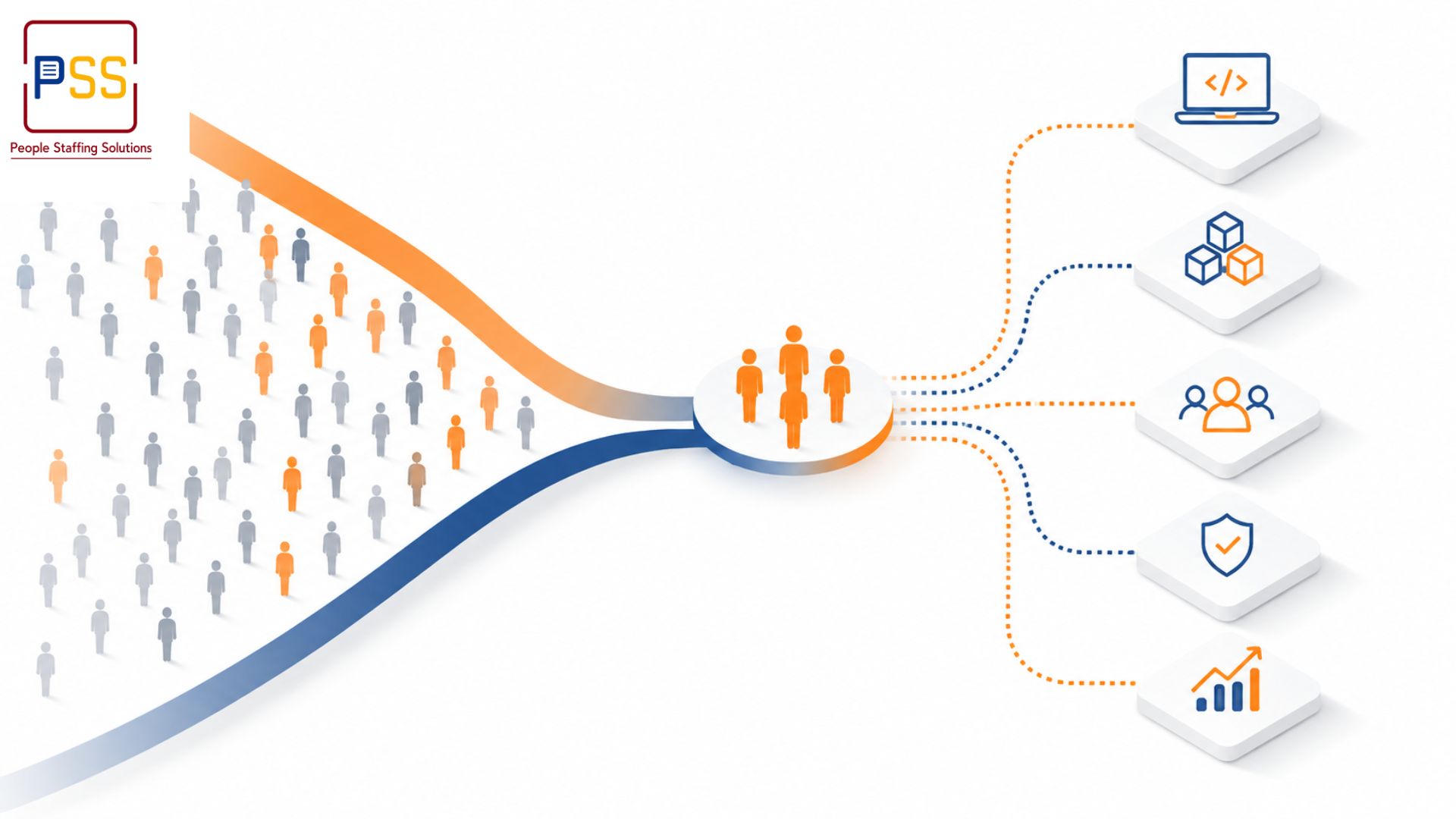
Most conversations about India’s “talent gap” default to a simple supply-and-demand story — not enough engineers for the demand. That story doesn’t hold up well against the data. India’s overall employability rate has been climbing, entry- and mid-level hiring pipelines are deep, and volume hiring for standard software engineering, QA, and support roles has, if anything, gotten easier over the past two years.
The real constraint sits further up the experience curve. Professionals with 8 to 15 years of experience represent a specific and narrower cohort: people who entered the industry during a much smaller hiring wave, who’ve had time to actually own outcomes rather than just execute tasks, and who’ve been through enough real production incidents, architecture decisions, and cross-functional negotiations to be trusted with ambiguity.
That cohort didn’t grow at the same rate the industry’s demand for it did. India’s tech workforce expanded dramatically over the past decade, but most of that expansion happened at the entry and early-mid level. The 8–15 year band is, proportionally, thinner than the demand curve assumes — and every function that depends on it is feeling the squeeze at the same time.
Where the Squeeze Shows Up Most
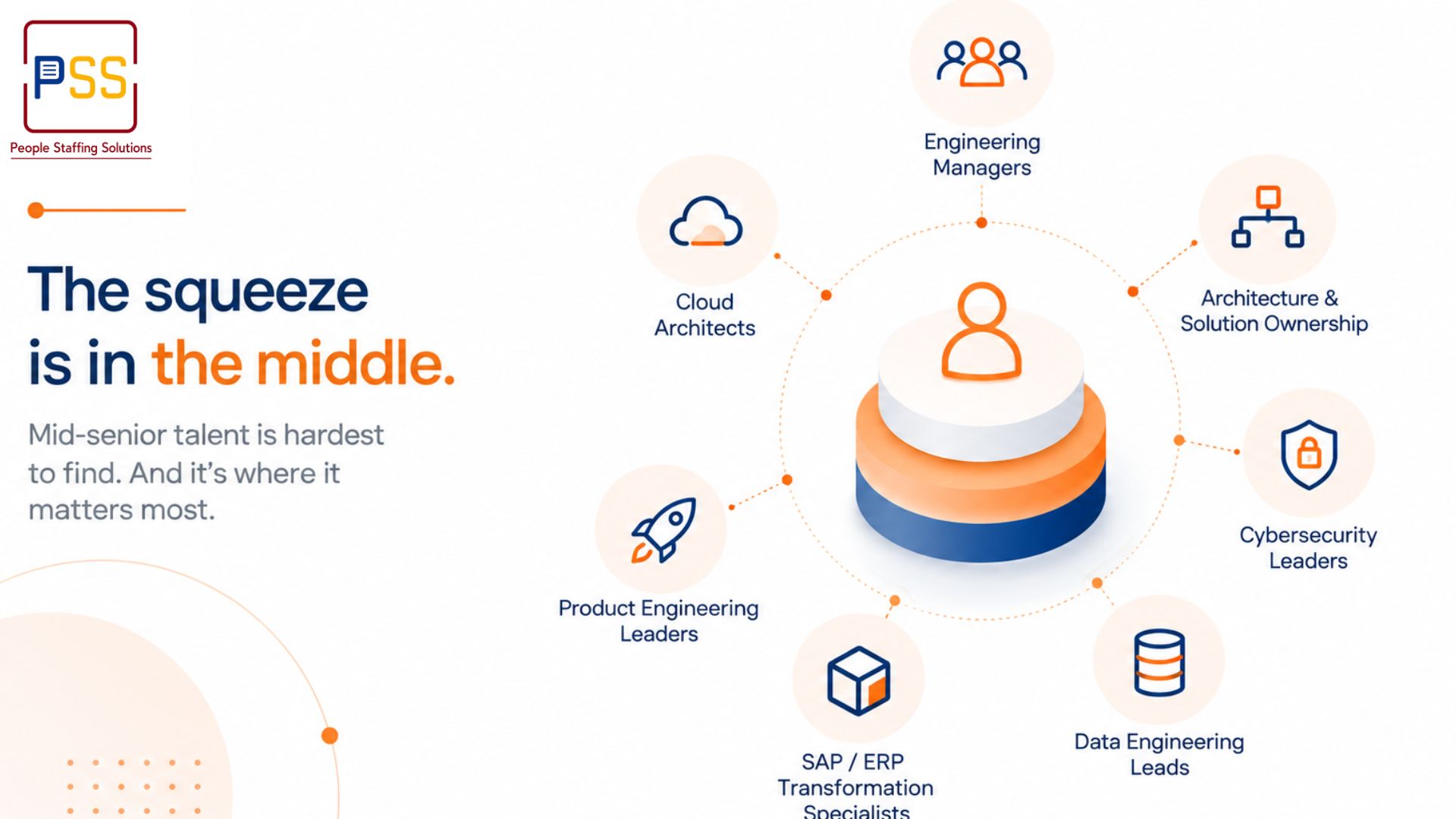
The bottleneck isn’t evenly distributed. It concentrates hardest in a handful of specific capability areas:
- Individual contributor vs. engineering manager shortage. Companies can usually find strong senior individual contributors faster than they can find engineering managers who can both code-review at depth and manage a team through ambiguity. The management layer of this cohort is thinner still.
- Architecture and solution ownership. Roles that require someone to own a system end-to-end — not just build a component of it — draw from a much smaller pool than headcount plans usually assume.
- Product engineering leadership. Leaders who’ve shipped and owned a product roadmap, not just a technical backlog, are in short supply relative to demand from both startups and enterprises building product-first teams.
- Cloud architects. Multi-cloud and hybrid infrastructure decisions increasingly need architects with real production scale experience, not certification-level familiarity.
- Cybersecurity leaders. Security leadership demand has outpaced the supply of professionals who’ve actually run incident response and security architecture at scale, not just compliance checklists.
- Data engineering leads. As AI and analytics initiatives multiply, the professionals who can design data platforms — not just write pipelines — are stretched thin across every company trying to hire one.
- SAP / ERP transformation specialists. Large-scale ERP transformation work draws on a small, senior, highly specialized pool that hasn’t grown at the pace transformation demand has.
Each of these is, on its own, a narrow hiring problem. Together, they add up to the same conclusion: the mid-senior band is where hiring plans are most likely to quietly stall.
The GCC Effect Makes This Worse, Not Better
Global Capability Centers have added real depth to India’s tech ecosystem — but their expansion is putting direct, sustained pressure on exactly this 8–15 year cohort. GCCs are no longer back-office operations competing for volume hires; they’re innovation hubs competing for the same senior architects, engineering leaders, and specialized technical talent that product companies and startups are trying to hire.
That competition shows up in three specific, measurable ways:
- Compensation escalation. When a handful of GCCs in a city start paying product-company-level compensation for senior talent, the entire local senior salary band moves — including for companies with no direct GCC competition.
- Shorter notice periods and faster exits. Senior professionals in high demand have more leverage to negotiate exit timelines, which shortens the runway hiring teams have to close a role once an offer is accepted.
- Aggressive counter-offer behaviour. As the senior pool gets scarcer, current employers are increasingly willing to counter-offer aggressively to retain the professionals GCCs and competitors are targeting — which means offer acceptance is no longer the end of the hiring process, it’s the start of a retention fight.

This Isn’t Just Anecdotal — the Research Backs It Up
There is already evidence that mid-career professionals represent a particularly constrained segment of India’s technology workforce. NIIT’s 2026 skills-gap study identifies this specifically as a major talent paradox: a workforce that looks abundant in aggregate, but is structurally thin at exactly the experience level most functions depend on to operate.
That paradox is precisely why so many hiring updates default to “the talent just isn’t out there” when a senior role sits open for months. The talent pool overall isn’t the problem. The specific band a company is hiring into is.

Why Companies Struggle to Build a Senior Bench
Most organizations don’t build a senior bench on purpose — it accumulates as a byproduct of hiring plans built for volume, not depth. That creates a few recurring failure patterns:
- Job descriptions written for the mid-level band get reused for senior searches, filtering out exactly the ambiguity-comfortable candidates the role needs.
- Compensation bands get set against last year’s market data, in a market where senior pay is moving faster than annual benchmarking cycles can track.
- Sourcing strategies built for volume — job boards, high-throughput screening — don’t reach passive senior candidates who are being sourced directly and aggressively by GCCs and competitors.
- Internal promotion pipelines aren’t deep enough to backfill senior departures, so every senior exit becomes an external search under time pressure.
None of these are talent-supply problems. They’re hiring-strategy problems that happen to surface as “we can’t find senior talent.”

What This Means for Your Hiring Plan
Volume hiring is becoming easier in India — tier-2 city expansion, rising employability, and deeper mid-level pipelines have made standard engineering and QA hiring genuinely more efficient than it was even two years ago.
Capability hiring is becoming harder, at the exact same time, in the exact same market. The 8–15 year cohort that owns architecture, leads engineering teams, and drives transformation work is being pulled in more directions by more well-funded competitors than at any point in the last decade.
Treating both as the same hiring problem — solvable with the same sourcing channels, the same timelines, and the same compensation logic — is where senior searches quietly stall for six months while volume hiring sails through in six weeks. The organizations getting this right are building distinct strategies for the two: high-throughput sourcing for volume roles, and a deliberate, well-funded, relationship-driven approach for the narrow senior band everything else depends on.

The Bottom Line
The talent shortage story in Indian tech has always been slightly wrong. It was never about too few people — it’s about too few people at the exact experience level that determines whether a function actually works. Volume hiring is a solved problem for most companies now. Capability hiring, at the 8–15 year mark, is the constraint that’s actually slowing growth — and it’s the one most hiring plans still aren’t built to solve.
Let’s connect for a Strategic Discussion!