Are India’s Tier-2 Cities Ready for High-Skill Technology Hiring?
- August 24, 2026
The Technology Talent Geography Shift: Are India’s Tier-2 Cities Ready for High-Skill Technology Hiring?
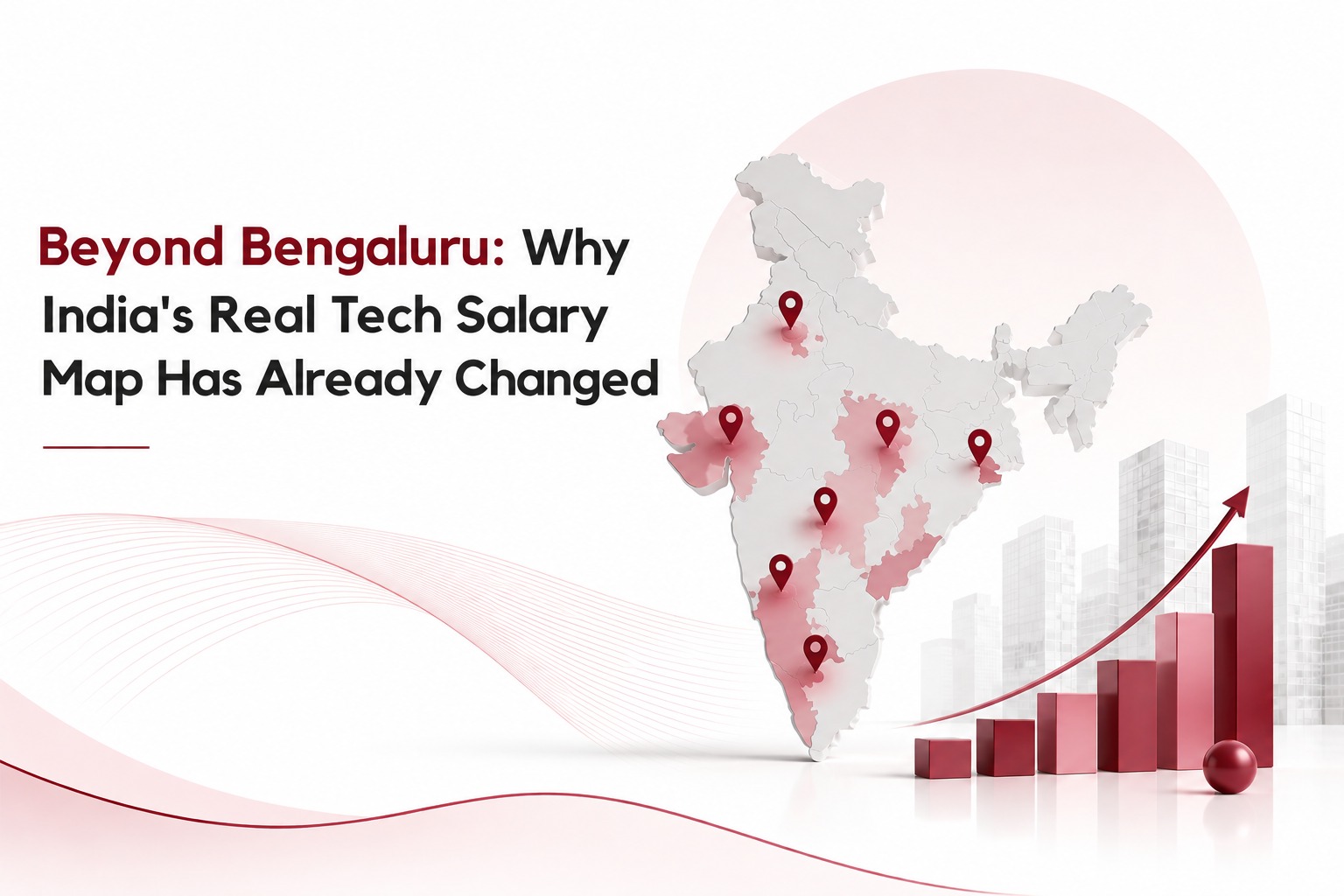
Tier-2 cities are absorbing a growing share of India’s tech hiring. Here’s an honest look at what they can handle today — and which roles should still stay in the metros.
The question CXOs are actually asking isn’t “should we hire outside Bengaluru.” Most already are. The real question is narrower and harder: which roles can genuinely move to a tier-2 city today, and which ones will quietly underperform if you move them too early.
- Tier-2 cities’ share of new tech job creation nearly doubled, moving from roughly 8% to 18% of the national total in five years
- Tier-1 hubs still hold the deepest senior talent bench and the highest GCC concentration — that gap hasn’t closed
- Tier-2 cities offer real cost and attrition advantages, but at the mid-level, not yet at the senior leadership level
- The right model for most companies isn’t “tier-1 or tier-2” — it’s splitting roles by seniority and function across both
What the Tier-1 Cluster Still Does Better
Bengaluru, Hyderabad, Pune, Chennai, and the NCR region (Gurugram and Noida) remain the country’s default hubs for a reason that has less to do with inertia and more to do with concentration. These are the cities where senior AI and specialized technology talent actually clusters — not because talent doesn’t exist elsewhere, but because the density of experienced professionals, mature engineering leadership, and Global Capability Centres is still heavily weighted toward these five markets.
That concentration matters most for roles where “good enough” doesn’t work: senior architecture decisions, AI research and platform-level engineering, and functions that depend on being physically near an ecosystem of specialized vendors, co-located leadership, and a dense peer network of similarly experienced professionals. It’s also where remote and global hiring channels — including GCC-driven mid- and senior-level recruitment — are most active, which keeps the talent pipeline replenished even as costs rise.
The trade-off is well understood: higher compensation benchmarks, higher attrition, and intensifying competition for the same narrow pool of senior AI-capable talent, concentrated in exactly these cities.

What the Tier-2 Cluster Actually Offers Today
Cities like Ahmedabad, Jaipur, Kochi, Coimbatore, Indore, Bhubaneswar, and Chandigarh are not simply cheaper versions of the tier-1 hubs — they carry genuine, independent technology capability, and the shift toward them is structural, not a pandemic-era blip. Tier-2 cities went from roughly 8% to 18% of new tech job creation over five years, and the trajectory is accelerating rather than leveling off.
What’s real about this shift:
- Cost advantage. Salary benchmarks in these cities sit meaningfully below the tier-1 hubs for comparable roles.
- Lower attrition. Professionals in tier-2 markets tend to be considerably more stable, with fewer competing employers actively poaching from the same local pool.
- Improving quality-of-life pull. Factors like commute time, cost of living, and lifestyle are increasingly influencing where experienced professionals choose to stay or relocate to — a pull that works in tier-2 cities’ favor as remote and hybrid norms have become permanent rather than temporary.
- Genuine mid-level depth. These markets now have real, demonstrable execution capability for standard software engineering, QA, support, and operational technology roles — not just entry-level headcount.
Description
Where Tier-2 Still Falls Short
This is the part most enthusiastic “move everything to tier-2” pitches leave out, and it’s the part that actually determines whether a relocation succeeds or quietly fails within a year.
- Senior leadership bench strength is still thin. Tier-2 cities have real mid-level capability, but engineering leadership, architecture-level ownership, and AI research talent are still concentrated in the tier-1 cluster. A tier-2 team without senior oversight attracted in from outside the city tends to drift without a strong technical anchor.
- GCC presence is real but uneven. Global Capability Centres are expanding into tier-2 markets, but the depth and maturity of that ecosystem still lags well behind Bengaluru, Hyderabad, and Pune, where GCCs have operated at scale for years.
- Hiring velocity for niche, high-skill roles is slower. A tier-2 city can fill a standard mid-level engineering req reasonably fast. A highly specialized AI research or platform architecture role can sit open considerably longer, simply because the qualified local pool is thinner.

Which Roles Should Move to Tier-2 — and Which Shouldn’t
The honest answer isn’t a location decision at all — it’s a role-design decision.
Good fits for tier-2 relocation: standard software engineering and QA at the mid-level, product support and operations-heavy technology roles, internal tooling and platform maintenance work, and stable execution-focused teams that benefit more from consistency and lower attrition than from proximity to a dense senior talent ecosystem.
Roles that should stay anchored in tier-1, at least for now: senior architecture and platform leadership, AI research and frontier model work, roles requiring deep, fast access to a specialized vendor and partner ecosystem, and any function where the cost of a slow, imperfect hire is higher than the cost of the tier-1 salary premium.
The model that’s actually working for companies managing this well isn’t a binary choice — it’s a deliberate split: build durable mid-level execution capacity in tier-2 cities, while keeping senior technical leadership either physically in tier-1 hubs or explicitly relocated in rather than assumed to be locally available. Teams built on the assumption that tier-2 can replicate a full leadership stack locally are the ones most likely to stall.

The Bottom Line
Tier-2 cities have earned a real seat at the table for technology hiring — the data on job creation and cost make that hard to dispute. But “ready for high-skill hiring” and “ready to replace tier-1 entirely” are different claims, and conflating them is where relocation strategies go wrong. The companies getting this right aren’t choosing a city. They’re choosing which roles genuinely need what tier-1 still offers, and building everything else where the cost, stability, and growing capability of tier-2 already make sense.
Let’s connect for a Strategic Discussion!